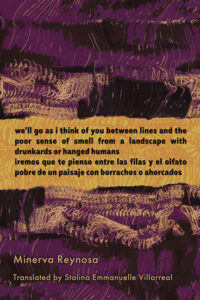
 we’ll go as i think of you between lines and the poor sense of smell from a landscape with drunkards or hanged humans by Minerva Reynosa from El Martillo Press
Minerva Reynosa’s we’ll go as i think of you between lines and the poor sense of smell from a landscape with drunkards or hanged humans is a furious, fragmented, deeply original work that transforms memory into a political and emotional landscape. Moving through Monterrey in the 1980s and 1990s, Reynosa fuses autobiography, cultural criticism, border consciousness, feminist rage, working-class history, and pop culture into poetry that is both improvised and meticulously orchestrated.
Structured as a series of “landscapes,” the collection accumulates force through repetition and variation. Selena, Gloria Anzaldúa, neighborhood mythology, family violence, economic precarity, Norteño music, and industrial Monterrey recur like refrains in a fever dream. Reynosa’s language swerves between lyricism and parody, tenderness and grotesque humor. A line about a sister dressing like Selena can suddenly open into meditations on feminicide, class identity, or linguistic displacement. The result is poetry that refuses stability, mirroring the instability of memory itself.
One of the collection’s greatest achievements is how it handles cultural memory. Selena becomes more than a celebrity; she emerges as a symbol of border identity, female visibility, and collective aspiration. Reynosa writes about her not with detached nostalgia but with intimate urgency, embedding Selena into family history and community consciousness. The passages surrounding Selena’s death are especially devastating, connecting personal grief to the broader violence inflicted on women in Mexico and along the borderlands.
The bilingual presentation intensifies the book’s themes of hybridity and displacement. Stalina Emmanuelle Villarreal’s translations preserve Reynosa’s jagged syntax, code-switching, humor, and musicality without smoothing out the difficult textures that make the poems so alive.
Reynosa is also remarkably unafraid of ugliness. Domestic violence, misogyny, urban poverty, bodily vulnerability, addiction, and emotional instability are all rendered with startling directness. Yet the collection never collapses into despair. There is too much movement, too much sound, too much life for that. The poems pulse with neighborhood voices, radio songs, gossip, memory fragments, and rebellious female energy. Even amid trauma, the book insists on survival through speech, rhythm, and reinvention.
What makes this collection especially compelling is its refusal to behave like “respectable” literary poetry. Reynosa mocks academic authority, destabilizes official narratives, and embraces excess, repetition, melodrama, and vernacular speech. The poems are lived rather than polished. They are noisy, unruly, contradictory, and emotionally exposed in ways that contemporary poetry often avoids.
This is a daring and memorable collection — one that reads like a collage of borderland consciousness assembled from family stories, pop songs, feminist theory, urban mythology, and historical violence. Reynosa creates a poetics of fragmentation that somehow feels whole because it remains emotionally true. The book lingers not only for its imagery and experimentation, but for its insistence that memory itself is a contested and political terrain.
While a resident of New York City, Richard Modiano became active in the literary community connected to the Poetry Project where he came to know Gregory Corso, Allen Ginsberg, Anne Waldman, William S. Burroughs and Ted Berrigan. In 2001 he was a programmer at Beyond Baroque Literary/Arts Center, joined the Board of Trustees in 2006, and from 2010 to 2019, he served as Executive Director. The Huffington Post named him as one of 200 people doing the most to promote poetry in the United States. Modiano is the winner of the 2022 Joe Hill Prize for labor poetry and is a Pushcart Prize nominee.