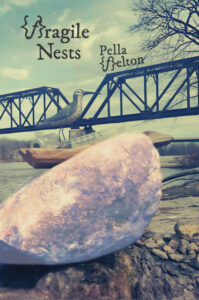
 {f}ragile Nests by Pella Felton from Roadside Press
Pella Felton’s {f}ragile Nests is a poetry collection haunted by archives: the archives of memory, performance, gender, family, religion, friendship, loss, and the body itself. Throughout these poems, Felton returns repeatedly to a central question: what remains when the stories we inherit no longer contain us?
The collection’s title proves apt. Nests are places of shelter, incubation, and belonging, but they are also temporary structures—fragile constructions built from found materials. Felton’s poems operate similarly, assembling scraps of personal history, queer theory, theatrical language, popular culture, and intimate confession into provisional homes for a self still in the process of becoming.
The book’s opening prologue announces its concerns immediately. Through a litany of origins—”I come from…”—Felton traces a life shaped by performance and misrecognition before arriving at the transformative declaration: “And now I will come from somewhere else.” This movement from inherited narrative toward self-authorship becomes the emotional and philosophical spine of the collection.
Birds recur throughout the book as a complex symbolic vocabulary. They appear as objects of affection, metaphors for identity, reminders of mortality, and embodiments of freedom that remain just beyond reach. In “A Poem About Birds,” “Chekhov’s Seagull,” “Trinket,” and “Eulogy for a Birdsong, 1987,” Felton explores the tension between presence and representation. We can preserve recordings, photographs, and memories, the poems suggest, but never fully recover the living thing itself. The archive remains a trace rather than a resurrection.
One of the collection’s greatest strengths is its ability to move between intellectual inquiry and emotional vulnerability. Felton draws openly from performance studies, queer theory, and archival scholarship, invoking figures such as Jacques Derrida, Peggy Phelan, Jill Dolan, and others. Yet these references never feel merely academic. Instead, they become tools for understanding lived experience—especially the experience of gender transition, grief, and self-reconstruction. The theoretical and the personal continually illuminate one another.
The collection is also deeply theatrical. Stages, scripts, audiences, costumes, and performance conventions appear throughout, often serving as metaphors for gender itself. Felton writes with the awareness of someone who has spent years inhabiting roles and interrogating them. The poems ask what happens when the performance becomes survival, and what becomes possible when the script is finally revised.
Perhaps the book’s most affecting passages are those that grapple with intimacy and memory. Poems such as “If You’re a Bird,” “Liveness,” “Turn the Barrel/Blood Work,” and “Jules” balance humor and heartbreak with remarkable dexterity. Felton possesses an ear for conversational rhythms and a gift for transforming personal anecdotes into meditations on longing, care, and embodiment. Even the collection’s funniest moments often carry a quiet ache beneath them.
Stylistically, {f}ragile Nests is expansive and eclectic. The poems range from lyric meditation to prose poetry, from elegy to cultural criticism, from devotional reflection to stand-up-comedy cadence. At times the collection risks excess, but that excess is deliberate. Felton’s voice is one of abundance—restless, associative, intellectually curious, and unwilling to simplify difficult truths for the sake of neat conclusions.
What ultimately distinguishes {f}ragile Nests is its commitment to complexity. The collection resists tidy narratives of transformation or redemption. Instead, it embraces contradiction: joy and mourning, faith and doubt, archive and presence, performance and authenticity. Felton understands that becoming oneself is not a destination but an ongoing practice of revision.
{f}ragile Nests by Pella Felton is available at https://www.magicaljeep.com/product/fragile/BD3A2AE5R6WR5DJPUSX7CIDO
While a resident of New York City, Richard Modiano became active in the literary community connected to the Poetry Project where he came to know Gregory Corso, Allen Ginsberg, Anne Waldman, William S. Burroughs and Ted Berrigan. In 2001 he was a programmer at Beyond Baroque Literary/Arts Center, joined the Board of Trustees in 2006, and from 2010 to 2019, he served as Executive Director. The Huffington Post named him as one of 200 people doing the most to promote poetry in the United States. Modiano is the winner of the 2022 Joe Hill Prize for labor poetry and is a Pushcart Prize nominee.