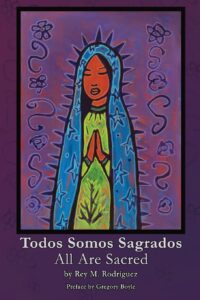
 Todos Somos Sagrados /All Are Sacred by Rey M. Rodríguez from El Martillo Press
Rey M. Rodríguez’s All Are Sacred is a bi-lingual poetry collection rooted in Boyle Heights, but its ambitions extend far beyond place. The poems function as acts of witness, memorial, and gratitude, chronicling the work of Proyecto Pastoral and the women who transformed a struggling Los Angeles community through courage, faith, and collective action. Rather than presenting the poet as the central figure, Rodríguez consistently places community at the center of the narrative, allowing the poems to become a chorus of voices rather than a solitary lyric meditation.
The collection’s greatest strength lies in its unwavering commitment to honoring ordinary people whose labor often goes unrecorded. Poems such as “For Paula Hernandez and All of the Moms Who Taught Us to See,” “Ver, Juzgar, Actuar,” “Sofia,” and “La Guardería” elevate childcare workers, mothers, organizers, and immigrants into the realm of the heroic. Rodríguez’s poetry insists that social transformation is not achieved through grand gestures but through cooking meals, caring for children, confronting violence, and opening doors to strangers. The repeated emphasis on sanctuary, shelter, and hospitality creates a moral framework that runs throughout the book.
One of the collection’s most effective recurring metaphors is the image of the garden. In “There is a Garden Growing in Boyle Heights,” the neighborhood itself becomes a living ecosystem sustained by immigrant labor and love. The poem rejects stereotypes imposed from outside the community and instead presents Boyle Heights as a place of resilience and flourishing. The metaphor reappears in “Sofia,” where community-building is described as the work of cultivation: breaking concrete, preparing soil, and patiently nurturing growth until “roses emerged.” These images are simple, but they gain power through repetition and accumulation.
Rodríguez’s style favors accessibility over formal experimentation. The poems are written in clear, direct language, often employing short lines, repetition, and catalogues of people, occupations, and actions. At times, this approach gives the work the feeling of oral history rendered into verse. The poems are less interested in ambiguity than in testimony. Readers seeking intricate metaphorical density or linguistic innovation may find the poetry straightforward, but that directness is also part of its effectiveness. The language relects the values celebrated in the collection: honesty, service, and clarity of purpose.
The strongest poems are those that dramatize moral encounters. “Open Your Heart,” for example, frames compassion not as charity but as mutual transformation. The poem’s conversation between a migrant and a priest avoids sentimentality by emphasizing reciprocity; the newcomer is not merely receiving help but expanding the community’s capacity for love. Likewise, “Ver, Juzgar, Actuar” gains its force from concrete examples of women organizing peace walks, confronting gang violence, and challenging institutional neglect. These poems succeed because they move beyond abstract ideals and show what solidarity looks like in practice.
Another notable achievement is the collection’s treatment of spirituality. Rodríguez presents faith not as doctrine but as action. The religious dimension of the poems emerges through service, inclusion, and radical hospitality rather than theological reflection. Father Gregory Boyle’s preface provides a useful lens for understanding the collection: the poems repeatedly return to “inclusion, non-violence, unconditional loving, kindness, and compassionate acceptance” as lived practices rather than abstract principles.
At times, the poems verge on the didactic. Their messages are often explicit, and some readers may wish for greater tension, complexity, or ambiguity. Yet the collection’s purpose is not primarily aesthetic experimentation. It seeks preservation — preserving stories, preserving memory, and preserving examples of community leadership that might otherwise be forgotten. Rodríguez himself acknowledges this documentary impulse in the acknowledgements, describing the project as an attempt to capture and preserve the spirit of Proyecto Pastoral and the women who built it.
Ultimately, the poems in All Are Sacred succeed because they embody the values they celebrate. They are generous, communal, and grounded in lived experience. Rodríguez offers a portrait of Boyle Heights that challenges narratives of poverty and dysfunction by foregrounding the people who create dignity in difficult circumstances. The collection serves as both a tribute and a call to action, reminding readers that the most profound forms of social change often begin with something as simple — and as difficult — as opening one’s heart.
This is a moving collection of community-centered poetry whose moral clarity, emotional sincerity, and celebration of grassroots leadership make it a valuable contribution to contemporary socially engaged poetry.
All Are Sacred by Rey M. Rodríguez is available at https://www.elmartillopress.com/product-page/todos-somos-sagrados-all-are-sacred
While a resident of New York City, Richard Modiano became active in the literary community connected to the Poetry Project where he came to know Gregory Corso, Allen Ginsberg, Anne Waldman, William S. Burroughs and Ted Berrigan. In 2001 he was a programmer at Beyond Baroque Literary/Arts Center, joined the Board of Trustees in 2006, and from 2010 to 2019, he served as Executive Director. The Huffington Post named him as one of 200 people doing the most to promote poetry in the United States. Modiano is the winner of the 2022 Joe Hill Prize for labor poetry and is a Pushcart Prize nominee.