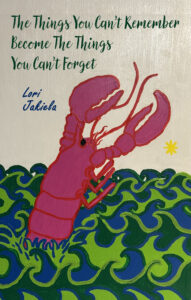
 The Things You Can’t Remember Become the Things You Can’t Forget by Lori Jakiela (Roadside Press)
Lori Jakiela’s The Things You Can’t Remember Become the Things You Can’t Forget is subtitled “an object/memoir in verse,” but that description hardly captures the ambitious emotional and intellectual terrain this remarkable collection traverses. Beginning with a tarnished silver jewelry box discovered during a closet cleanout, Jakiela unfolds a meditation on memory, mortality, love, regret, aging, family, and the strange power of ordinary objects to hold the stories we cannot quite remember and cannot entirely let go.
At the center of the book is the jewelry box itself– forgotten, unclaimed by any clear memory of origin, lined with red velvet and playing the theme from Cats. Around this object Jakiela constructs a sprawling constellation of associations that move effortlessly between Marie Kondo, Tom Waits, Allen Ginsberg, Dawn of the Dead, Catholic school nuns, lobsters, Pittsburgh malls, first marriages, and dementia. What might sound chaotic in lesser hands becomes, under Jakiela’s control, an elegant demonstration of how memory actually works: nonlinear, recursive, contradictory, and deeply human.
One of the collection’s great achievements is its voice. Jakiela writes with the rare combination of intellectual curiosity and blue-collar candor that has characterized her best work. She can pivot from literary allusion to self-deprecating humor within a few lines. A discussion of memento mori gives way to memories of a cruel nun named Sister Ignatius; reflections on mortality coexist with jokes about celebrity-themed vibrators and glitter-glue disasters at a mall gift shop. The humor is not ornamental. It functions as a survival mechanism, a way of confronting loss without succumbing to sentimentality.
The poems repeatedly return to questions of what deserves to be remembered and what is inevitably lost. In one of the collection’s most affecting sequences, Jakiela recalls a first marriage she can barely reconstruct while vividly remembering a lobster served during an engagement trip to Toronto. The contrast becomes an unsettling metaphor for the unreliability of memory itself. The lobster remains; the husband fades. The meal survives; the relationship dissolves. Such moments reveal the collection’s deeper concern: not merely what we remember, but why certain memories persist while others disappear.
Jakiela’s handling of aging is especially moving. Throughout the book, she confronts the fear of forgetting—car keys, names, origins, histories — while also recognizing that memory is not simply a record-keeping system. It is an emotional archive. The collection culminates in reflections on her father-in-law’s dementia, where forgotten facts coexist with vivid recollections of songs, childhood, love, and sensory experience. These closing poems suggest that memory’s truest function may not be accuracy but meaning.
Formally, the poems operate as linked lyric essays, accumulating resonance through repetition. Phrases, images, and motifs recur like musical themes: the jewelry box, Marie Kondo, Sister Ignatius, Tom Waits, lobsters, “Cabbage Heads,” and the Portuguese word saudade. The effect is cumulative and immersive, creating a memoir assembled from fragments rather than chronology. The collection trusts readers to follow its associative leaps, and that trust is rewarded.
What distinguishes The Things You Can’t Remember Become the Things You Can’t Forget is Jakiela’s refusal to separate the profound from the ridiculous. A suburban mall, a music box playing Cats, baby teeth stored in velvet, ketchup used to clean silver, and Frank Sinatra songs become vehicles for exploring grief, desire, identity, and mortality. Jakiela understands that our lives are built not from grand narratives but from the strange objects and stories we carry forward.
In the end, this is a book about what remains. Not perfect memories, but fragments. Not certainty, but longing. Not possession, but attachment. Jakiela transforms an ordinary jewelry box into a powerful symbol of the way memory operates—holding what we treasure, what we lose, and what continues to haunt us. The result is a funny, heartbreaking, and deeply satisfying collection that confirms Lori Jakiela as one of the most distinctive memoirists and poets working today.
While a resident of New York City, Richard Modiano became active in the literary community connected to the Poetry Project where he came to know Gregory Corso, Allen Ginsberg, Anne Waldman, William S. Burroughs and Ted Berrigan. In 2001 he was a programmer at Beyond Baroque Literary/Arts Center, joined the Board of Trustees in 2006, and from 2010 to 2019, he served as Executive Director. The Huffington Post named him as one of 200 people doing the most to promote poetry in the United States. Modiano is the winner of the 2022 Joe Hill Prize for labor poetry and is a Pushcart Prize nominee.