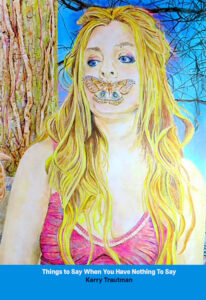
 Things to Say When You Have Nothing to Say by Kerry Trautman (Roadside Press)
Kerry Trautman’s Things to Say When You Have Nothing to Say is a collection that quietly dismantles its own title. These poems are anything but empty — they teem with observation, sensory immediacy, and a restless, searching intelligence that turns the mundane into sites of revelation. What emerges across the collection is a poetics of attention: to roads, rivers, birds, bodies, memory, and the strange emotional residue of everyday life.
The opening poem, “All Roads Lead to The Gasconade River,” sets the thematic current. Movement — literal and existential — dominates: roads leading to water, choices between safety and risk, instinct versus hesitation. The poem’s imagery is tactile and grounded (splashing through creek-covered roads, patting a roadside horse), yet it gestures toward a philosophy of surrender: like the falling tree limb, one “figures it out” in motion. This becomes a guiding ethos for the collection.
Trautman’s strength lies in her ability to braid the physical and the psychological. In “Where Trees Grow,” a childhood memory of eating peaches becomes a meditation on growth, chance, and the quiet hope that something discarded might root itself into meaning. Similarly, “The Blue Hole” transforms a roadside attraction into an extended metaphor for emotional inaccessibility and the unknowability of others. These poems don’t force epiphany; they circle it, letting it surface organically.
There is also a persistent preoccupation with voice — its absence, distortion, or misrecognition. “The Sound of Your Own Voice” is one of the collection’s most compelling pieces, exploring identity through birdsong and misheard names. The speaker’s yearning “to befriend” what she cannot fully recognize mirrors a broader human anxiety: how do we know each other, or even ourselves, when perception is so unreliable? This question echoes throughout the book, especially in poems about relationships, missed connections, and the fragility of communication.
Formally, Trautman is playful without being showy. She moves between prose poems, fragmented lines, and spatial experimentation, often using white space to mimic thought patterns or emotional dislocation. In poems like “Flightless,” the visual scattering of language mirrors the thematic concern with perspective and interpretation. Elsewhere, her prose poems accumulate detail in a way that feels almost essayistic yet always returns to a lyrical core.
The collection is also notable for its tonal range. There is humor (“Listening to a Poet in a College Chapel…” with its obsessive calculations of sneezes and sodium intake), sensuality (“Bolstering,” “To Everyone I Could Have Fucked but Didn’t”), and a deep undercurrent of grief and longing (“When She Found My Father Dead,” “Imagining Myself Alone”). Even in its more erotic or bodily poems, the focus is less on explicitness than on vulnerability, memory, and the negotiation of desire.
What binds these varied pieces together is a sense of lived-in authenticity. Trautman writes from within the textures of domestic life — children, kitchens, gardens, small towns — without romanticizing them. Instead, she reveals their strangeness: the way a sink full of cantaloupes can evoke motherhood, or how a basement during a storm becomes a theater of quiet dread and resilience.
If there is a critique to be made, it is that the collection’s abundance can occasionally diffuse its impact. With so many poems operating at similar emotional registers, certain images — birds, water, roads — risk becoming overly familiar. Yet even this repetition feels intentional, like returning to the same landscape under different light.
Ultimately, Things to Say When You Have Nothing to Say is a book about trying—trying to articulate, to connect, to understand, to remain present in a world that constantly pulls attention elsewhere. Trautman suggests that language may never fully capture experience, but the act of reaching — of noticing, of recording, of risking expression — is itself a form of meaning.
These are poems that listen as much as they speak, and in that listening, they find their quiet, persistent power.
While a resident of New York City, Richard Modiano became active in the literary community connected to the Poetry Project where he came to know Gregory Corso, Allen Ginsberg, Anne Waldman, William S. Burroughs and Ted Berrigan. In 2001 he was a programmer at Beyond Baroque Literary/Arts Center, joined the Board of Trustees in 2006, and from 2010 to 2019, he served as Executive Director. The Huffington Post named him as one of 200 people doing the most to promote poetry in the United States. Modiano is the winner of the 2022 Joe Hill Prize for labor poetry and is a Pushcart Prize nominee.