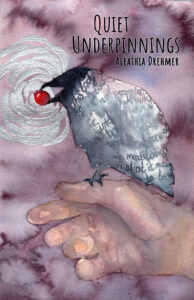
 Quiet Underpinnings by Aleathia Drehmer (Roadside Press)
Aleathia Drehmer’s Quiet Underpinnings is a collection deeply attentive to how life accumulates—through seasons, through grief, through the small, human gestures that tether us to one another and to the land. These poems are rooted in lived experience, where ecological awareness, love, and loss are inseparable, and where the natural world is not metaphor alone but an active participant in survival.
In “Grid of Civilization,” Drehmer frames the collection’s central tension early: the clash between human progress and the ancient rhythms it disrupts. Looking out at “homes and criss-crossing wires,” she names this landscape plainly as “this grid of civilization, destruction,” while the cold wind carries “the ancients cry over what we’ve done in the name of status and money.” The poem’s quiet dread—its wondering whether “spring will ever show her face again”—sets the emotional and ecological stakes for the book as a whole.
Yet Quiet Underpinnings is equally committed to tenderness. In “The Smell of Earth,” hope rises from the soil itself as fingers dig into dirt after winter, the “smell of earth rising to make us smile.” The speaker watches starlings in murmuration and imagines a nightingale’s song, a fleeting moment where the world briefly aligns. These poems suggest that restoration, if it comes at all, begins in attention—in noticing insects waking, soil breathing, hands warming another hand.
Drehmer’s treatment of grief is particularly striking. In “Totem Rising,” a red-tailed hawk appears again and again—first alive, then dead, then alive once more—each sighting layered with meaning. The hawk becomes a conduit for ancestry and memory: “I think of my father, his soul forever trapped inside birds.” By the poem’s end, an “invisible totem” rises from the earth, built of dirt, sky, and wind, carrying ancestral voices. Grief here is not static; it moves, transforms, and watches from above.
Personal loss and anxiety surface with raw clarity in “I’ll Meet You At The River,” where fear is named as the well from which everything else rises—fear of love, of time, of distance. The image of anger breaking free “like a thousand colorless nymphs” is unsettling and precise. Relief comes not through resolution, but motion: rock hunting by the river, the sound of water reminding the speaker of “what we are traveling toward instead of keeping us swimming in a shallow eddy.” The river becomes a place of recalibration rather than escape.
Throughout the collection, Drehmer excels at capturing intimacy without sentimentality. In “Life is Improvisation,” a piano’s minor chords and a lover’s fingers brushing an Achilles heel become moments of embodied learning—“I am learning to mine his silence for the words I can’t hear.” In “The Rich Stuff,” shared labor—shovels hitting dirt on the opening day of fall fill—becomes a metaphor for shared dreaming, each lift and throw an offering to the future.
Even in moments of communal joy, grief remains quietly present. “Friendsgiving” closes on the ache of remembering that it is the speaker’s father’s birthday, a reminder that celebration and loss often sit at the same table. This emotional layering gives the collection its depth; nothing is allowed to exist in isolation.
Quiet Underpinnings is a book about noticing—about frost on gardens, anchor ice clinging to rocks, fireflies losing their dark spaces, and the quiet courage required to keep reaching for light. Aleathia Drehmer’s poems do not shout their truths. They trust the reader to lean in, to listen closely, and to recognize themselves in the slow, persistent work of being alive.
While a resident of New York City, Richard Modiano became active in the literary community connected to the Poetry Project where he came to know Gregory Corso, Allen Ginsberg, Anne Waldman, William S. Burroughs and Ted Berrigan. In 2001 he was a programmer at Beyond Baroque Literary/Arts Center, joined the Board of Trustees in 2006, and from 2010 to 2019, he served as Executive Director. The Huffington Post named him as one of 200 people doing the most to promote poetry in the United States. Modiano is the winner of the 2022 Joe Hill Prize for labor poetry and is a Pushcart Prize nominee.