Letters That Breathe Fire by Margaret Randall, New Village Press
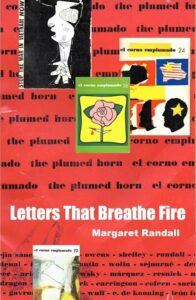 Letters That Breathe Fire is not merely a book of correspondence; it is a living archive of how literature once moved through the world—slowly, stubbornly, and with moral urgency. Drawn from the letter sections of El Corno Emplumado / The Plumed Horn, one of the most important independent literary magazines of the 1960s, the volume captures a transnational conversation among poets, artists, editors, and activists who believed that words mattered enough to risk something for them.
At the center of this exchange stands editor and cofounder Margaret Randall, whose presence shapes the book as much through judgment and framing as through selection. Randall emerges not as a neutral curator but as an engaged intelligence—attentive to craft, alert to power, and unafraid of conflict. Editing, for her, is an ethical practice. Her decisions to publish letters that argue, offend, or contradict one another reflect a belief that literature must remain accountable to the political and cultural realities it inhabits. That stance anticipates her later life as a poet, translator, feminist, and activist: multilingual, internationalist, and exacting in matters of conscience.
One of the book’s most powerful revelations is the centrality of letters themselves. In an era before email, grants culture, and constant literary convenings, the letter was the infrastructure of artistic life. These pages show how relationships were built by hand, across borders, via steamship and mail truck. The editors’ commitment to reproducing correspondence—often handwritten, sometimes raw or argumentative—turns the volume into a collective autobiography of a generation. The letters do not orbit the magazine; they are its bloodstream.
The range of voices is astonishing. Canonical figures—Thomas Merton, Julio Cortázar, Ernesto Cardenal, Denise Levertov, Lawrence Ferlinghetti, Allen Ginsberg, Ezra Pound—appear here not as monuments but as working writers: burdened by teaching loads, beset by censorship, worried about money, and uncertain about their own work. Alongside them are younger poets and readers writing from Nicaragua, Canada, Australia, and the United States, whose letters pulse with yearning, anger, humor, and ambition. The effect is leveling and humanizing. Fame dissolves in the shared urgency of making work and finding allies.
El Corno Emplumado’s bilingual mission—making work from the South available in the North and vice versa—comes alive in these exchanges. Translation is shown not as a technical afterthought but as a political and aesthetic act, negotiated through trust and sustained correspondence. George Bowering’s letters, charting the making of The Man in Yellow Boots, reveal how books were shaped collaboratively, through vulnerability and mutual respect. The finished work feels less like a product than the residue of a relationship.
Politics courses through the book without ever hardening into doctrine. Letters document censorship battles, government repression, ideological rifts, and the constant pressure exerted on artists to choose sides. Julio Cortázar’s open letter exposing intellectual piracy by a Venezuelan cultural magazine is a devastating assertion of literary ethics as a form of anti-colonial resistance. Elsewhere, Randall and her coeditors deliberately publish opposing political positions, not to sanitize disagreement but to confront it in public. The result is a rare record of intellectual struggle conducted in good faith, under real risk.
Equally vivid is the texture of daily life. Writers describe surviving on one meal a day, grading stacks of papers, raising children amid manuscripts and drawings. Visual artists—Elaine de Kooning, Leonora Carrington, Juan Soriano, Carlos Cofeen Serpas—move through these pages alongside poets, reinforcing the sense of a shared, improvised cultural ecosystem. Even the magazine’s children are present, contributing drawings and portraits, reminding us how inseparable art was from life.
The book does not romanticize its era. Gendered labor appears plainly, often unremarked upon by the men who benefit from it, offering a quiet but telling counterpoint to the period’s rhetoric of liberation. At the same time, figures such as Raquel Jodorowsky and Denise Levertov assert themselves as central voices, complicating any simple narrative of exclusion or marginality.
As the magazine enters its final years—financially precarious, politically targeted, yet artistically fearless—the letters grow more urgent. Government support is withdrawn, subscription prices rise, and friends respond with small checks and large solidarity. Sergio Mondragón’s farewell poem to El Corno Emplumado reads as both love letter and reckoning, honoring seven years of collective risk, intimacy, and endurance.
For contemporary readers—especially writers accustomed to instantaneous communication—Letters That Breathe Fire offers a bracing corrective. It recalls a literary culture built on patience, trust, and conviction rather than speed or visibility. The debates that animate these pages—about censorship, translation, political responsibility, and editorial ethics—remain unresolved, newly relevant.
In preserving these letters, Margaret Randall does more than document a moment; she models a way of being in literary life. The fire these letters breathe comes not only from their historical circumstances but from the seriousness with which their writers—and their editor—believed that literature could still be dangerous, and therefore necessary.
Pre-order Letters that Breathe Fire at https://www.booksamillion.com/p/Letters-That-Breathe-Fire/Margaret-Randall/9781613322833
While a resident of New York City, Richard Modiano became active in the literary community connected to the Poetry Project where he came to know Gregory Corso, Allen Ginsberg, Anne Waldman, William S. Burroughs and Ted Berrigan. In 2001 he was a programmer at Beyond Baroque Literary/Arts Center, joined the Board of Trustees in 2006, and from 2010 to 2019, he served as Executive Director. The Huffington Post named him as one of 200 people doing the most to promote poetry in the United States. Modiano is the winner of the 2022 Joe Hill Prize for labor poetry and is a Pushcart Prize nominee.