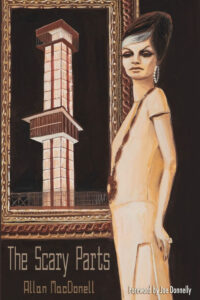
 The Scary Parts by Allan MacDonell (Punk Hostage Press)
The Scary Parts is a compact, sharp-edged book about fear—not the cinematic kind, but the quiet, professional, social, and existential varieties that accrue as life narrows its options. Allan MacDonell approaches fear the way a seasoned essayist and fiction writer would: circling it, baiting it with humor, letting it speak just long enough to expose its pettiness and its power. Published by Punk Hostage Press, the collection fits squarely within that house’s affinity for intelligent misbehavior and cultural skepticism.
The table of contents reads like a taxonomy of adult dread: fear of success, fear of failure, fear of starting, fear of the dark, fear of being alone, fear of time running out. What MacDonell does especially well is refuse to treat these fears as discrete. They bleed into one another, reinforcing the sense that fear is less a set of obstacles than an operating system. Even the titles oscillate between instruction (It’s Time to Make Fear Your Friend), confession (Fear of Starting Something), provocation (Fuck Fear), and parable (The Useful Coward, The Triumph of the Chicken). The book signals early on that it will not resolve fear so much as anatomize it.
The final piece, “A Little Afterward: Nobody Wants to Hear Your Story,” serves as both capstone and quiet thesis. It is a meticulously observed narrative about storytelling itself—who gets listened to, who gets rewarded, and why merit so often has little to do with it. Sandy, the divorced protagonist, is neither villain nor hero. He is intelligent, self-aware, vain, insecure, and paralyzed by the belief that he possesses a story of genuine worth that the world stubbornly refuses to recognize. Around him orbit younger neighbors, a waitress, a successful raconteur named Hunter Point, a series of girlfriends, and finally an Uber driver—each a mirror reflecting a different version of narrative confidence.
MacDonell’s satire is precise rather than cruel. Hunter Point’s rise is not depicted as fraudulent so much as inevitable. He understands—perhaps instinctively—that storytelling is performance, not truth-telling, and that charisma and timing outweigh depth or originality. Sandy’s tragedy is not that his David Bowie story is unheard, but that he believes being unheard is an injustice rather than a condition of modern life. The title’s verdict—Nobody Wants to Hear Your Story—lands not as insult but as diagnosis.
Stylistically, MacDonell excels at social detail: the post-divorce self-inventory, the aesthetics of Los Angeles aspiration, the costume logic of authenticity, the language of people who have “breakthroughs in the work life.” His sentences are clean, observant, and often very funny, especially when describing the soft tyranny of optimism. Humor here is not a release valve; it’s a scalpel.
What ultimately binds The Scary Parts together is its insistence that fear persists even when its ostensible causes disappear. Success does not cure fear; obscurity does not either. Being listened to is not the same as being understood, and being understood does not guarantee satisfaction. In the book’s closing movement—Sandy riding alone, listening to yet another confident stranger narrate his own redemption arc—MacDonell lands on a quietly devastating insight: everyone is already telling their story, all the time. The fear is not that no one is listening. The fear is realizing that this might not matter.
The Scary Parts is a smart, unsettling, and darkly funny collection that will resonate with readers attuned to the anxieties of creative life, middle age, and cultural noise. Punk Hostage Press has published a book that doesn’t offer comfort, but something more durable: recognition.
The Scary Parts by Allan MacDonell is available here
While a resident of New York City, Richard Modiano became active in the literary community connected to the Poetry Project where he came to know Gregory Corso, Allen Ginsberg, Anne Waldman, William S. Burroughs and Ted Berrigan. In 2001 he was a programmer at Beyond Baroque Literary/Arts Center, joined the Board of Trustees in 2006, and from 2010 to 2019, he served as Executive Director. The Huffington Post named him as one of 200 people doing the most to promote poetry in the United States. Modiano is the winner of the 2022 Joe Hill Prize for labor poetry and is a Pushcart Prize nominee.