Pella Felton reviews Neon Pastoral by Valerie Perreault
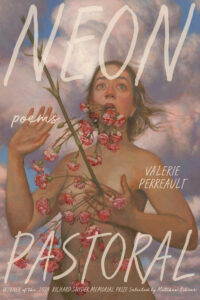
Perreault, Valerie (2025) Neon Pastoral (Poetry Collection). The Ashland Poetry Press. 97p. $17.95 (Paperback) Winner – 2024 Richard Snyder Memorial Prize
Early in Neon Pastoral, Valerie Perreault addresses the mysterious subject of her Richard Snyder Memorial Prize-winning collection with a bold promise: “You are almost ready to be born, baby”. Perreault means this in both a beat and a literal context. On a narrative level, the “baby” is Lala, the mysterious protagonist whom Perreault’s audacious beat poems address, usually in the second voice.
However, this declaration reads more like an apology than a celebration. Neon Pastoral isn’t interested in celebrating landscape in the traditional pastoral sense; Lala must survive it like a sojourn through hell.
In many ways, Neon Pastoral functions as a modern Divine Comedy—a three-act journey through an inferno where hell is postmodern, capitalist, and viscous. Perreault casts herself as a strange blend of protective mother, trusted confidant, and white-hat sadist. She pits her screaming banshee protagonist against a never-ending gauntlet of needs, wants, desires, and intrusions, which she must learn to persevere against. Images in the collection attack Lala’s sensorium, identity, and sense of self. Perreault commands each inch of the page like a sovereign, spitting enjambments, stanza breaks, and shocking turns of phrase at the reader like detritus moving through the transom. Her words fly at Lala in full media res, providing both vessel and obstacle for her. However, as the images of the poems evolve, the hellscape quickly encompasses Lala’s body. Perreault invokes a corporeal relationship typified by the viscerality of mistaking an octopus for a heart and the alienation of looking in the mirror at a “sad man with no child. In “TMTWS (The Machine That We Serve)” recurring images of “egg-shaped pods” and a machine called “Your Honor Your Holy Chosen Eggness That Wants Only Your Essence” suggest a dysphoric version of Lala that isn’t simply being born; she is about to crack.
As much as she is interested in exploring the existential nightmares of being alive, Perreault refuses to give herself or the reader any credit for this lofty goal. Perreault rejects easy metaphors, instead crafting perverse and often baffling turns of phrase that playfully mock the reader for expecting predictable teleologies. Yet it is in this mischievously antagonistic absurdity that the collection establishes its addictive, subversive, and hilarious pleasures. Because Perreault has bestowed on Lala the birthright of sarcasm, each linguistic spur feels like an act of resistance. When Perreault throws in a witty aside, she does so as a triumphant strike against the constant stream of mediocrity and conformity both she and her foundling endure. Perreault is teaching her warrior princess how to wield irony as both weapon and shield against a growing depletion of soul. Consequently, Perreault’s assaultive, maximalist poem titles—”VR feline LARPing Pills for Coping in the Apocalypse” and “Pantone Color-of-the-Year Canaries as Part of the Khloe Kardashian Collection” are my favorites — reflect a desire to prevent Lala from becoming too predictable. Her allusions to McDonald’s, Friends, and Amazon Prime ground the collection’s more ecstatic moments with a startling almost tossed-off sincerity. In “Wait Before I Get To That,” Perreault introduces her to, then apologizes for, two of the most constant images in poetic verse, finding a way to subvert both into a dazzling high-camp tableau:
“Death (I know, I know)
Stands in the front yard in a caftan.
Smoking a spliff and flipping the bird. Speaking
of birds,
Death is a single black feather that..
Floats into your open palm You reach out
to catch a raindrop and it places itself inside instead, like a jewel.
This hell doesn’t need unpacking; it needs a broom and dustpan.
Elsewhere, Perreault buries the leads of her verses behind poetic cul-de-sacs. The opening to “The Funniest Planet” provides a rebellious and counterintuitive way into a classic cliché, noting that “When the cage rattles /it reminds me that I live within one.” This off-balance couplet subverts more traditional and clichéd uses of the caged-bird metaphor in verse. Perreault knows we already understand the poetic image of the cage, so she instead centers the phenomenal experience of the imprisoned Lala, thus extending the metaphor. Other times, such as in “Snow Leopardess,” she decries the inadequacy of style and poetics to speak to the cruel and crass realities of modern existence:
Call the police
nobody gives a shit about your slant rhyme
when we’re shooting each other in the streets
Which we are .
Still, this crafty cynicism conceals a deeper, more delicate—and occasionally more hopeful—center. The structure, skill, and sweep of Neon Pastoral elevate the collection from being an exercise in brilliant voice and verse to something meant to live inside our bodies. Poems from the second act of the collection, such as “Little Dove,” describe a protagonist in whom a “slow ripening” and “sweet melon smell” have given way to a more ascendant version of Lala. Other poems like “Adventure Song” explicitly initiate her into the pleasures of the physical world, inviting her to “Roll down your socks, Lala. / Feel the wheat against your legs,” suggesting that even if our bodies are hell, they are the only way to see the sun. The collection’s title poem describes a moment of transcendence on a small sailboat where Perreault, no longer obscured by her relationship with Lala, suggests that:
All of this will have been worth it,
for the hatch on the sailboat… onto my dreaming face.
Yet these grace notes never let us, as readers, forget the commodified, corporatized, almost prosaic landscape in which this body lives. Neon Pastoral uses the imprints of capitalism to brand its nightmare onto our everyday world. The poems rarely stray far from the immediacy of our daily life, yet by no means endorse that immediacy. Perreault seems to be preparing Lala to survive their current moment rather than triumph over it. For those of us reckoning with the same struggles to survive an ecosystem that is constantly trying to destroy us, this journey feels frighteningly prescient.
Maybe we are all Lala, and we’re all about to be born again… in hell.
Neon Pastoral is currently available for purchase through most online retailers and through Ashland Poetry Press at www.ashlandpoetrypress.com You can find out more about the author at https://www.valerieperreault.com
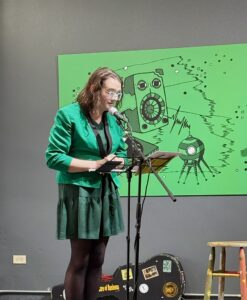 Pella Felton is a poet, performer, and independent scholar stationed out of Northwest Ohio. She holds a certificate in Performance Studies from Bowling Green University and has performed her work at various poetry festivals and events throughout the Midwest including the Toledo Fringe Festival, BGSU Winter Wheat Literary Festival, and the Literary Underground Festival. She is also an accomplished media and performance scholar who frequently presents her research at conferences such as the Pacific Ancient and Modern Language Association, The Great Lakes Association of Sound Studies, and the Society for Media and Cinema Studies. Pella lives in Bowling Green, Ohio.