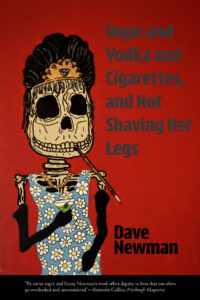
 Dope and Vodka and Cigarettes, and Not Shaving Her Legs by Dave Newman
from Roadside Press
Dave Newman’s Dope and Vodka and Cigarettes, and Not Shaving Her Legs is a devastating, funny, and deeply humane novel about addiction, poverty, family loyalty, and the complicated ways love survives inside dysfunction. Told through a series of short, sharply observed chapters, the novel follows a boy growing up in western Pennsylvania as he watches his mother’s addiction consume their household while his father struggles heroically—and often unsuccessfully—to hold the family together.
Newman’s greatest strength is his voice. The narrator speaks with the clarity of adulthood while preserving the emotional logic of childhood. This dual perspective allows the book to achieve something difficult: it exposes the realities of addiction without reducing its characters to victims or villains. The mother is reckless, manipulative, and self-destructive, yet she remains charismatic, funny, and capable of genuine tenderness. The father emerges as one of the novel’s most memorable figures—a working-class man whose relentless effort to love his family becomes its own form of tragedy.
Structurally, the novel resembles a mosaic. Many chapters are only a page or two long, functioning as snapshots, memories, confessions, and reflections. The cumulative effect is powerful. Rather than building through conventional plot mechanics, the book accumulates emotional weight through repetition and detail: Swiss Cake Rolls during parental fights, disappearing lunch money, endless explanations for a mother’s sickness, and a father’s stubborn acts of care. These recurring images create a portrait of childhood shaped by instability but sustained by affection.
Newman also demonstrates an exceptional ear for dialogue. The exchanges between family members are lived-in and authentic, often balancing heartbreak and humor within the same conversation. The humor is particularly important. Without it, the material could become overwhelming. Instead, the comedy functions as survival, revealing how families endure circumstances that might otherwise destroy them.
The novel belongs to a tradition of working-class American literature associated with writers such as Andre Dubus, Larry Brown, and, in its emotional honesty and regional specificity, even echoes of Raymond Carver. Yet Newman’s voice remains distinctly his own—more conversational, more openly affectionate, and often more willing to embrace sentiment without irony.
Perhaps the novel’s most remarkable achievement is its refusal to simplify love. The narrator never entirely abandons his mother, even as he documents the damage she causes. Likewise, the father’s devotion is portrayed not as saintliness but as persistence. The book understands that family bonds often survive long after reason suggests they should.
Dope and Vodka and Cigarettes, and Not Shaving Her Legs is a moving portrait of addiction’s collateral damage, but it is equally a celebration of endurance, memory, and working-class resilience. Dave Newman has written a novel that is painful without being hopeless, unsparing without being cruel, and ultimately memorable because of the compassion it extends to every character who inhabits its pages. It is one of those rare books that manages to break your heart while reminding you why hearts continue beating in the first place.
Dope and Vodka and Cigarettes, and Not Shaving Her Legs by Dave Newman is available now at https://www.magicaljeep.com/product/dope/5XUDK4F64JD2JENXGT5UCZRW
While a resident of New York City, Richard Modiano became active in the literary community connected to the Poetry Project where he came to know Gregory Corso, Allen Ginsberg, Anne Waldman, William S. Burroughs and Ted Berrigan. In 2001 he was a programmer at Beyond Baroque Literary/Arts Center, joined the Board of Trustees in 2006, and from 2010 to 2019, he served as Executive Director. The Huffington Post named him as one of 200 people doing the most to promote poetry in the United States. Modiano is the winner of the 2022 Joe Hill Prize for labor poetry and is a Pushcart Prize nominee.