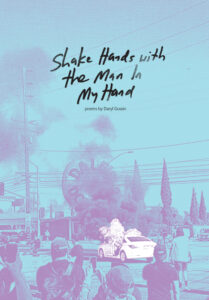
 Shake Hands with the Man in My Hand by Daryl Gussin from There’s Only Peace in Death Press
Daryl Gussin’s Shake Hands with the Man in My Hand (There’s Only Peace in Death Press) is a collection that thrives on contradiction: sincerity and irony, intimacy and estrangement, humor and dread. The attached poems reveal a voice that is at once self-aware and disarmingly earnest, grounded in the mundane textures of contemporary life—public transit, relationships, bodily anxieties—yet persistently reaching toward something like moral or emotional clarity.
What stands out immediately is Gussin’s tonal agility. In “Belly Fat,” the speaker oscillates between self-deprecation and fragile hope, confessing to “shallow thoughts” while still clinging to “utopian possibilities” that feel just out of reach . The poem’s central image — a “lost little bunny” tracking warmth — risks sentimentality, but is rescued by the framing context of exhaustion and creative survival. This is emblematic of the collection’s larger project: to locate tenderness without denying absurdity or despair.
That tension sharpens in “Acceptance of Some Horrible Fate,” where a moment of potential violence on public transit spirals into a meditation on “negative space” — what is left behind when a life is erased . Gussin’s prose-like lineation allows thought to accumulate in real time, mimicking the mind’s attempt to process shock after the fact. The poem resists neat resolution; instead, it offers a kind of ethical afterimage, concluding not with certainty but with a fragile assertion of having “lived as good a life as anything I could think of.” The phrasing is telling—tentative, almost provisional — suggesting that meaning is something constructed after the fact rather than discovered.
The collection is also unafraid of the grotesque or the excessive. “Old Photos” pushes desire into uncomfortable territory, layering nostalgia with bodily imagery that borders on the surreal . The language here is intentionally overripe, even abrasive, forcing the reader to confront how memory and longing distort perception. Similarly, “Young Couple” transforms envy into a kind of petty, almost comic hatred, rooted not in romance but in intellectual insecurity — the trivial yet piercing humiliation of not knowing crossword answers . Gussin excels at these moments, where the speaker’s pettiness becomes a lens for broader anxieties about worth and self-comparison.
Formally, many of the poems adopt a conversational, paragraph-like structure, but Gussin knows when to break into lyric compression. “Pressure” uses repetition and spatial movement to embody relational tension, turning the environment itself into a participant in emotional conflict . Meanwhile, “Skipped” distills an entire relationship into a sequence of avoided milestones, its simplicity amplifying the quiet devastation of choosing absence over engagement .
There is also a strong socio-political undercurrent, most explicitly in “We Are Those Broke-Ass Skanks,” which blends humor with critique of public health systems and civic responsibility . The poem’s voice is irreverent but not cynical; it acknowledges complicity while still imagining a more humane alternative. This aligns with the collection’s recurring concern: how to live ethically in a world that feels structurally broken.
Perhaps the most haunting piece among the attachments is “I Know,” which captures a parent’s confrontation with a child’s dawning awareness of violence –specifically, the normalization of lockdown drills . The repetition of “do you know” becomes a kind of echo chamber, collapsing innocence into inevitability. Here, Gussin’s strength lies in restraint; the emotional weight emerges not from grand statements but from the unbearable ordinariness of the conversation.
Across these poems, Gussin’s style can feel deliberately unpolished — lines spill over, syntax stretches, and diction shifts abruptly between registers. But this roughness is integral to the work’s authenticity. The poems read less like crafted artifacts and more like lived experiences caught mid-thought, which lends them an immediacy that smoother verse might lack.
If there is a critique to be made, it is that the collection occasionally leans too heavily on its own discursiveness. Some passages circle their ideas rather than deepening them, and the reliance on conversational rhythm can blur distinctions between poems. Yet even these moments contribute to the overall ethos: a refusal to tidy up experience for the sake of aesthetic neatness.
Ultimately, Shake Hands with the Man in My Hand is a collection about negotiating existence in a state of cognitive and emotional overload. It is concerned with how we process violence, intimacy, envy, and hope in a world saturated with information and contradiction. Gussin does not offer answers so much as he documents the ongoing attempt to find them — and in that attempt, the work finds its quiet, persistent power.
Shake Hands with the Man in my Hand by Daryl Gussin is available for purchase at https://www.darylgussin.com/product/shake-hands-with-the-man-in-my-hand-by-daryl-gussin
While a resident of New York City, Richard Modiano became active in the literary community connected to the Poetry Project where he came to know Gregory Corso, Allen Ginsberg, Anne Waldman, William S. Burroughs and Ted Berrigan. In 2001 he was a programmer at Beyond Baroque Literary/Arts Center, joined the Board of Trustees in 2006, and from 2010 to 2019, he served as Executive Director. The Huffington Post named him as one of 200 people doing the most to promote poetry in the United States. Modiano is the winner of the 2022 Joe Hill Prize for labor poetry and is a Pushcart Prize nominee.