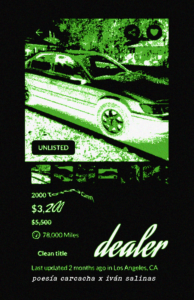
 Dealer by Iván Salinas from There’s Only Peace in Death Press
Dealer by Iván Salinas, published by There’s Only Peace in Death Press, reads less like a collection and more like a live wire — erratic, charged, and impossible to hold without feeling the current. What emerges across these poems is not just a poetics of fragmentation, but a poetics of acceleration: language pushed to the brink of combustion, identity split and remixed in real time, the city coursing through every line like voltage.
Take “My fingers squeeze the black nipple poking the dashboard,” where the poem itself becomes a vehicle — erratic, slang-heavy, and dangerously alive. The narrator “restarts Trip B” while “Trippin Balls Behind the wheel,” collapsing the boundaries between driver, drug, and destination. The repetition of “B”—“B B B B B Btch Btch Btch” — isn’t just sonic play; it’s a stuttered engine, a glitch in the linguistic system, a refusal of coherence that mirrors the chaos of Los Angeles traffic and the psychic overload of its inhabitants. The poem doesn’t describe motion; it enacts it, swerving through registers, languages, and identities with reckless precision.
This kinetic instability finds a different register in “Quarters (self–portrait at 25),” where time itself becomes transactional. Here, the narrator “empties the meters / to buy me more verses,” turning poetry into currency and survival into a kind of perpetual debt. The imagery of coins, meters, and “the sound of change / all over the world” reframes existence as something spent and reclaimed in fragments. Even celebration is undercut — “Cop cuts a slice / and threatens you with your birthday” — suggesting that time, like the city, is something policed, portioned, and weaponized. The poem’s desire “to accomplish nothing more! / than to live in the left pocket / where night is eternal” reads as both resignation and resistance: a refusal to participate in the forward march of productivity.
Vehicles recur throughout the collection as both literal and symbolic bodies. In “Arguments to euthenize a vehicle,” the car becomes an ailing organism, its “oil slick guts” bled out across domestic space. The question of whether to “resurrect you with a spell” turns mechanical failure into a metaphysical dilemma, linking ecology and desire. Driving is framed as compulsion — “to drive is to live” — yet also as harm, implicating both the individual and the system in cycles of damage. The poem’s closing image — “From shattered glass / The galaxy is born” — suggests that even destruction produces its own warped cosmology.
That entanglement of oil, blood, and survival reaches a stark articulation in “Ballad of my Gas Tank.” Here, petroleum is rendered as force and death sentence simultaneously: “In oil, there is blood to feed and be fed.” The poem collapses global economies into bodily necessity, where consumption becomes indistinguishable from violence. References to war, extraction, and depletion — “the barrels are running low”—echo through a voice that is both prophetic and exhausted. The line “Battery Killed The Gasoline Star” refracts pop culture into ecological elegy, underscoring the absurdity and inevitability of collapse.
Across these poems, Salinas refuses aesthetic distance. The work is immersive, abrasive, and deliberately unstable. Code-switching is constant, not as ornament but as necessity — English and Spanish colliding, mutating, and coexisting in ways that reflect lived experience rather than literary convention. The tone swings from manic humor to existential dread, often within the same breath. Syntax fractures, repetition overwhelms, and meaning emerges less through narrative than through accumulation and pressure.
What holds Dealer together is not coherence but intensity. These poems operate like systems under strain — linguistic, economic, ecological — each one threatening to break apart even as it generates new forms. The city, particularly Los Angeles, is not just a backdrop but a circulatory system: traffic, meters, and gasoline all feeding into a shared pulse of urgency.
At times, the excess is disorienting. The density of imagery and velocity of shifts can feel like too much — too loud, too fast, too fragmented. But that is precisely the point. Dealer doesn’t ask to be neatly understood; it demands to be experienced, endured, and inhabited.
In the end, Salinas offers no resolution — only immersion in a world where everything is in motion, everything is for sale, and everything is on the verge of breaking. The result is a body of work that feels immediate, unstable, and unmistakably alive.
While a resident of New York City, Richard Modiano became active in the literary community connected to the Poetry Project where he came to know Gregory Corso, Allen Ginsberg, Anne Waldman, William S. Burroughs and Ted Berrigan. In 2001 he was a programmer at Beyond Baroque Literary/Arts Center, joined the Board of Trustees in 2006, and from 2010 to 2019, he served as Executive Director. The Huffington Post named him as one of 200 people doing the most to promote poetry in the United States. Modiano is the winner of the 2022 Joe Hill Prize for labor poetry and is a Pushcart Prize nominee.