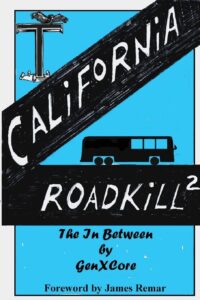
California Roadkill2 by GenX Core from Mystic Boxing Commission
GenX Core’s California Roadkill2, the follow up to California Roadkill from the same publisher in 2022, is not a comfortable book, nor does it pretend to be. It operates in a raw, unstable register — emotionally, stylistically, and philosophically –rooted in what the novel repeatedly names “The In Between.” That phrase becomes both setting and condition: a space between sobriety and relapse, past and present, identity and dissolution. The result is a work less concerned with narrative resolution than with immersion in a fractured state of being.
From its opening address to the reader, the novel establishes an intimate and confrontational tone. It collapses distance, insisting not on redemption but on recognition—on the shared experience of alienation, exhaustion, and longing. The voice is jagged and immediate, moving fluidly between lyrical introspection and abrasive, unfiltered confession. This oscillation defines the book’s style: at one moment poetic and expansive, at the next brutally direct, often within the same breath.
There are clear echoes of Beat literature, surf noir, and recovery narratives, but GenX Core reshapes these influences into something distinctly contemporary. The prose often mimics the rhythms of thought itself — fragmented, recursive, obsessive. Repeated phrases and internal counting create a kind of psychological tempo, reinforcing the narrator’s anxious, hyper-aware consciousness. Rather than presenting a polished narrative, the book reads like a transmission — urgent, unstable, and deeply personal.
California, in this novel, is not a backdrop but a living, contradictory force. The coastline is rendered with both reverence and menace: beautiful, expansive, and indifferent. Surfing sequences stand out as some of the book’s most vivid passages, capturing both the physical intensity of the ocean and its symbolic weight. Being caught in “The In Between” of the waves becomes an apt metaphor for the characters’ lives — suspended, directionless, and subject to forces beyond control.
The characters themselves feel less like fixed individuals than like embodiments of different responses to that instability. Jimmy, the narrator, is detached and perceptive, sober but not at peace. Donny channels chaos into physical risk, replacing substances with adrenaline. Rich, newly sober, clings to a personal philosophy he calls “Science,” an attempt to impose meaning and structure on an otherwise incoherent world. Hana, perhaps the most striking figure, moves through the narrative with a kind of feral clarity –simultaneously grounded and unmoored, her presence both confrontational and symbolic.
What unites these characters is not growth in any conventional sense, but their shared entanglement in contradiction. Recovery is not portrayed as triumph; it is partial, fragile, and often self-deceptive. The novel resists the comforting arc of transformation, instead emphasizing persistence—endurance within uncertainty. Memory, too, is treated with suspicion. Nostalgia is seductive but unreliable, a force that distorts as much as it reveals.
Throughout, the book returns to the tension between belief and skepticism. Rich’s concept of “Science” — a personal, quasi-spiritual framework — stands in contrast to Jimmy’s more detached, analytical worldview. Their exchanges give the novel a philosophical undercurrent, raising questions about fate, agency, and the human need to impose meaning on suffering. No single answer emerges, and that ambiguity feels intentional.
At times, the density of introspection and the fragmentation of the narrative may challenge readers. The characters are often abrasive, the emotional terrain unrelenting. Yet these qualities are inseparable from the book’s power. California Roadkill2 does not seek to comfort or resolve; it seeks to evoke, to confront, and to linger.
Ultimately, the novel reads as a kind of spiritual autopsy — an examination of what remains when the illusions of control, identity, and narrative coherence begin to fall away. It is not polished, but it is deeply felt and often haunting. For readers drawn to raw, introspective fiction that engages with addiction, memory, and the myth of California, it offers a striking and memorable experience.
Purchase California Roadkill2 by GenX Core at https://www.amazon.com/California-Roadkill-2-Genxcore/dp/B0GVVQWGGV/
While a resident of New York City, Richard Modiano became active in the literary community connected to the Poetry Project where he came to know Gregory Corso, Allen Ginsberg, Anne Waldman, William S. Burroughs and Ted Berrigan. In 2001 he was a programmer at Beyond Baroque Literary/Arts Center, joined the Board of Trustees in 2006, and from 2010 to 2019, he served as Executive Director. The Huffington Post named him as one of 200 people doing the most to promote poetry in the United States. Modiano is the winner of the 2022 Joe Hill Prize for labor poetry and is a Pushcart Prize nominee.