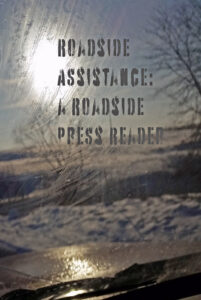
 Roadside Assistance: A Roadside Press Reader
edited by Dan Denton & Michele McDannold
There’s something refreshingly unvarnished about Roadside Assistance: A Roadside Press Reader — a book that refuses polish in favor of presence. As the publisher’s note makes clear, this is not a curated “best of,” but a living cross-section of a small press built on instinct, community, and a commitment to voices shaped by lived experience rather than institutional expectations. That ethos permeates the anthology from first page to last.
What emerges across its 200+ pages is less a unified aesthetic than a shared temperature: raw, immediate, and often bruised. The collection gathers forty-eight writers, and while their styles diverge — lyric, narrative, confessional, surreal — the emotional register remains strikingly consistent. These are poems and prose pieces grounded in work, addiction, grief, sex, memory, and survival. Factories, bars, hospital rooms, and back roads recur not as symbols but as actual places where life is endured and occasionally illuminated .
One of the anthology’s strengths is its refusal to romanticize this terrain. Alan Catlin’s barroom poems, for instance, strip away any lingering myth of the dive as a site of camaraderie, revealing instead a space of decay and slow violence. Dan Denton’s prose on factory labor extends this realism into economic critique, exposing the machinery not only of production but of exploitation — temporary labor, bodily exhaustion, and the precarious dignity of work. These pieces don’t posture; they report from within.
At the same time, the anthology is not without lyric grace. Ignatius Valentine Aloysius and David Allen Sullivan open the book with a sequence that balances spiritual attention and personal wreckage, finding fleeting transcendence in mist, breath, and birdsong. Elsewhere, poets like Johnny Cordova and Aleathia Drehmer navigate memory and loss with a quieter, more meditative intensity. Their work suggests that even in a collection so rooted in grit, there remains space for stillness, for reflection, for something like reverence.
Humor, too, threads through the book, often as a defense mechanism. Todd Cirillo’s “Useful Poetry” wryly dismantles poetic pretension while reaffirming poetry’s strange utility — whether as emotional ballast or literal furniture shim. Pella {f}elton’s meta-poetic riffs push this further, mocking both the poet’s ego and the absurd economics of literary life. These moments prevent the anthology from collapsing under its own weight; they remind us that survival often includes laughter, however bitter.
The anthology resists the canonizing impulse; it privileges inclusion over refinement, community over gate keeping. What ultimately holds the book together is not style but conviction. As the editors note, each piece carries the sense that it “needed to exist.” That urgency is palpable. Whether in the stark brutality of addiction narratives, the tenderness of elegies, or the restless searching of spiritual poems, the writing is necessary rather than ornamental.
Roadside Assistance is, in this sense, an apt title. These are roadside voices –caught between destinations, stalled, moving again, telling their stories from the shoulder of experience. The anthology doesn’t promise resolution or coherence. Instead, it offers something more honest: a record of people writing because they must, because the alternative is silence.
And in a literary landscape often dominated by polish and pretense, that kind of necessity is not only refreshing, but vital.
Roadside Assistance: A Roadside Press Reader is available at https://www.magicaljeep.com/product/roadside/SO7LETPOXJR5T4LEQK36FBRE
While a resident of New York City, Richard Modiano became active in the literary community connected to the Poetry Project where he came to know Gregory Corso, Allen Ginsberg, Anne Waldman, William S. Burroughs and Ted Berrigan. In 2001 he was a programmer at Beyond Baroque Literary/Arts Center, joined the Board of Trustees in 2006, and from 2010 to 2019, he served as Executive Director. The Huffington Post named him as one of 200 people doing the most to promote poetry in the United States. Modiano is the winner of the 2022 Joe Hill Prize for labor poetry and is a Pushcart Prize nominee.