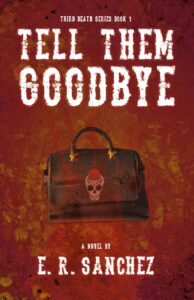
 Tell Them Goodbye by E. R. Sanchez (Fried Potato Press)
Tell Them Goodbye is a brutal, tender, and deeply human coming-of-age novel that refuses to romanticize migration while still honoring the hope that makes it inevitable. Through the voice of Sino, a Mexican teenage boy fleeing violence, poverty, and inherited silence, E. R. Sanchez delivers a story that feels lived-in rather than imagined—one stitched together by memory, fear, longing, and small acts of courage.
What strikes first is the voice. Sino narrates with a plainspoken intimacy that carries enormous emotional weight. His observations—about goats on a dirt road, the smell of sweat and sewage in town, the way money feels when it’s crisp and new—are deceptively simple. Sanchez understands that trauma doesn’t announce itself with flourish; it seeps in through repetition, through what a character avoids saying, through what becomes normal. The novel’s language mirrors Sino’s limited access to formal education, yet it is rich with metaphor, rhythm, and cultural specificity. This creates a powerful irony: a narrator who “can’t read” written words but reads the world with devastating clarity.
At the heart of the book is violence as inheritance. Sino’s father is both protector and abuser, capable of heroic brutality against animals and unforgivable brutality against his son. Sanchez never flattens him into a monster; instead, he presents a man shaped by land, patriarchy, and survival, passing that damage down like property. This complexity extends to Adal, the cartel figure whose casual cruelty represents a different but parallel system of power. The ranch, the cartel, and even migration itself become structures that demand obedience and extract bodies.
Equally compelling is the novel’s portrayal of brotherhood and loyalty, especially between Sino and his cousin Martín. Their relationship—fraught with irritation, tenderness, and unspoken dependence—anchors the narrative emotionally. Martín’s quiet protectiveness contrasts with Sino’s internal volatility, giving the story balance. When Sino feels “alone and empty,” it is often Martín’s presence, not freedom itself, that keeps him moving forward.
Sanchez is especially sharp in scenes involving Americans passing through Mexico. The spring-break surfers Rick and Brian are not villains, yet their obliviousness is cutting. They consume Mexico—its waves, its women, its drugs—with the same ease they’ll later return home. Through Sino’s eyes, their casual entitlement becomes quietly damning. These moments avoid preachiness; instead, they reveal how power operates when one group can always leave.
The title, Tell Them Goodbye, echoes throughout the novel like an unfinished instruction. Goodbyes here are rarely clean or spoken aloud: goodbye to childhood, to family, to land, to moral certainty. Even death—Javier’s execution, Blanca’s disappearance—arrives without ritual or closure. The border crossing itself, rendered in near-surreal fragments of water, darkness, and animal signals, feels less like an arrival than a stripping-away.
By the time Sino reaches El Norte, the reader understands that freedom is not the absence of fear, but the decision to keep walking anyway. Sanchez resists easy triumph. Survival comes at a cost, and hope is fragile, earned daily.
Tell Them Goodbye is an essential novel—not because it explains migration, but because it embodies it. It reminds us that behind every border statistic is a body that remembers smells, songs, and wounds. Sanchez has written a story that lingers, uncomfortable and necessary, long after the last page.
While a resident of New York City, Richard Modiano became active in the literary community connected to the Poetry Project where he came to know Gregory Corso, Allen Ginsberg, Anne Waldman, William S. Burroughs and Ted Berrigan. In 2001 he was a programmer at Beyond Baroque Literary/Arts Center, joined the Board of Trustees in 2006, and from 2010 to 2019, he served as Executive Director. The Huffington Post named him as one of 200 people doing the most to promote poetry in the United States. Modiano is the winner of the 2022 Joe Hill Prize for labor poetry and is a Pushcart Prize nominee.