Between the Walls
My old lady and I hitched to California. In the early seventies there were thousands of us in San Francisco. But it wasn’t the sixties anymore. We were homeless. No one used that word though. There were too many of us. We didn’t know that it got cold there in the winter. Everyone thought California was warm. When it began to snow one of the guys somehow cut into the side of an apartment building. They pulled the insulation out from the plaster wall, and everyone slid single file into the space between the walls deep into the building.
There was no way to move. There was nowhere to go. But we were warm until morning. It was impossible to leave until everyone behind us slid back out.
From between the walls I could hear people. I could hear people fighting, screaming, making love, music playing. I could hear the murmur of talking, crying, the drone of a TV. We could smell when someone was cooking making our stomachs gurgle. We slept or half-slept standing like horses. Sometimes we took turns leaning on each other. Sometimes someone would fall. Then there would be swearing and hushing so no one in the rooms would know we were behind the walls.
Just before San Francisco my old lady had a miscarriage. She was in lots of pain, blood, and a tiny person dead. We went to the hospital to have her cleaned up. Later at the Salvation Army they would separate us. Men were on one floor and women on the other. Everyone was to be on the street by 6 a.m. After a sleepless night she would sneak into the upper lofts of the Salvation Army and hide. She would go for days without sleep until she nearly went crazy.
By San Francisco there was less acid. By the ‘70s the drug of choice was speed. There were no stray cats in the Haight because all the speed freaks would catch them and eat them. The roads in San Francisco slant up and down in all directions, houses leaning at odd angles from the sloping street, trees and sea, a sideways perspective, and the bright Spanish colors in a multilevel maze.
There between the walls I was so tired. I slept, but I didn’t sleep. I dreamt but couldn’t dream. Around and above the sounds from the rooms mixed with nightmares and danced with memories. Every second was a book. All around life played on invisible stages humming in a beehive. Some of the dreams were from my childhood, and some were from the road. Some of these half-dreams went all the way back. Nodding in and out I remembered my birth. That was when I first tried to kill myself. I wrapped the umbilical cord around my neck. When they pulled me out I was purple. That was the same day I had almost killed my mother. She never forgave me. As soon as I was big enough I was gone.
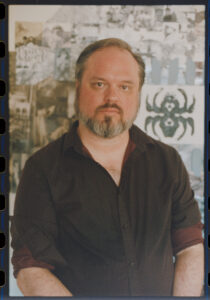
Photo by Leah Wendzinski
Westley Heine is the author of Busking Blues: Recollections of a Street Musician and Squatter (Roadside Press 2022), a short story collection 12 Chicago Cabbies (Newington Blue Press 2021), a poetry collection Street Corner Spirits (Roadside Press 2023), a novella Picture Book (Page Telegram Press 2024), and a collection of short stories and poems Cloud Watching in the Inferno (Roadside Press 2025). Most recently Roadside Press has released his new novel The Boys in Black (2026). Heine was a 2025 poetry judge for the Society of Midland Authors, is Pushcart Prize nominated, twice the featured performer at the original poetry slam at The Green Mill in Chicago, featured at Underground Lit Fest in Toledo, Beyond Baroque in L.A., Spec’s in San Francisco, GonzoFest in New York City, and was the poet chosen to represent Illinois at the Route 66 Poetry & Arts Festival 2025. Currently he is a writer in residence at the Osage Arts Community in Belle Missouri.