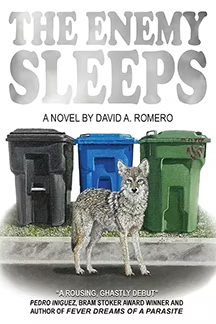
 The Enemy Sleeps by David A. Romero (El Martillo Press)
David A. Romero’s The Enemy Sleeps is a suburban California thriller with the pulse of social realism and the teeth of a morality tale. Set in the fictional city of Harper, the novel unfolds like a slow camera pan across a quiet cul-de-sac—until the camera catches something moving in the brush, something feral, and the entire neighborhood begins to feel like a trap.
Romero’s achievement is that he writes violence not as spectacle but as consequence. The book is tense, readable, and cinematic, yet it never lets the reader forget that the ugliest horrors are rarely supernatural. They are human. They are institutional. They are inherited.
From the opening moments of the prologue, Romero establishes Harper as a place where nature and civilization are not separate but locked in combat. The coyote in “Harper’s Canyon” is not just an animal but a symbol—an ancient survivor, “one of the last survivors of a pack that had once flourished in the region,” now reduced to prey. Romero’s prose lingers on the coyote’s eye, targeted by “a silver ring” of a Winchester rifle, and in that image the entire novel announces itself: a story about what happens when the powerful decide they have the right to eliminate what makes them uncomfortable.
The hunter Robert Parsons is introduced with a chilling calm. He isn’t written as a cartoon villain, but as a recognizable American archetype: working-class masculinity, entitlement to land, entitlement to dominance. His muttered line—“There’ll be a lot more of them if I don’t get her now”—could apply just as easily to coyotes as to immigrants, the poor, or anyone deemed invasive. Romero knows exactly what he’s doing. The coyote is a metaphor that keeps returning, shifting shape, until it becomes inseparable from the human story.
Even Robert’s son Neal, silently sharpening his knife beside him, becomes an omen. The knife is described as Neal’s “most prized possession,” and Romero makes sure we notice the ritual of sharpening, the quietness, the obedience. The child is being groomed into the same worldview: domination as tradition.
One of the novel’s greatest strengths is Romero’s attention to physical detail, particularly in domestic spaces. In Chapter 1, when Michael Martinez surveys his new neighborhood on Indian Run, Romero gives us the tract-home landscape in sharp suburban realism: dew on the newspaper, the smell of manure carried on the breeze, the “manufactured perfection” of a community that promises safety and success.
But then comes the Weaver home.
Romero describes it with such grotesque specificity—rotting beams, termite damage, curtains turned “putrid yellow,” piles of abandoned mail—that the house feels less like a setting than a corpse. Michael’s reaction is immediate: “disgust and unease.” The house becomes an early signal that Harper is not simply “nice suburbia.” It’s suburbia with rot underneath, suburbia where abandonment is contagious.
That rot is also social. Michael is introduced as a man who has “worked so hard, waited too long,” and who believes he has earned his place. He is proud of the upward mobility Harper represents. Yet Romero subtly undermines him with the headline Michael misses: “Door-to-door solicitor goes missing.” The novel is constantly doing this—letting the characters ignore warning signs while the reader watches dread accumulate in the margins.
Romero’s social commentary is sharpest when it refuses easy binaries. The Martinez family are not idealized saints. They are people carrying their own prejudices and contradictions, shaped by capitalism’s cruel logic of scarcity.
Michael, in particular, is a fascinating and infuriating figure. He is a Mexican-American man who has clawed his way into comfort, and he polices the boundaries of that comfort with the zeal of a convert. When Edward sees the Salvadoran gardeners across the street, he feels “a rush of elation,” relieved to see other Latine people. But Michael’s response is venomous:
“It’s bad enough they’re here… They have to bring their children too.”
It’s a devastating line, because Romero doesn’t make it unbelievable. He makes it depressingly familiar. Michael’s casual hatred is the hatred of someone terrified of being dragged back down the ladder. In Romero’s Harper, assimilation isn’t peace—it’s a desperate performance, and the price of belonging is often cruelty toward those with less power.
This makes The Enemy Sleeps feel politically intelligent. It isn’t simply about racist white neighbors versus immigrant outsiders. It’s about how fear and status infect everyone, how systems of class and race train people to see each other as threats.
Romero excels at turning place into a character. VistaView, the stalled housing development in Chapter 2, is a perfect example. It’s described as both hope and scam, both dream and curse. The sign—“VistaView Coming Soon”—has been there for years, and locals joke the development is cursed. Romero uses this half-finished suburbia as a symbol of American promise deferred: always almost affordable, always just out of reach.
The paragraph describing how residents might “sell their houses below, cashed in their kids’ college funds… willingly plunged themselves into hundreds of thousands of dollars of debt” is bitterly funny and bleak. Romero understands that the American dream in 21st-century California often looks like self-destruction dressed as ambition.
Edward Martinez, entering James K. Polk High in Chapter 3, provides one of the novel’s most human sequences. Romero captures the sensory overload of adolescence and displacement: the crush of bodies, the unfamiliar racial mix, the paralyzing feeling of not belonging. Edward becomes “like a rock in the middle of the river,” and the metaphor is perfect: immobile, swallowed by motion.
This section is quietly poignant, and it grounds the book’s later violence in something personal and real. Edward isn’t simply a plot device; he’s a kid trying to survive a new world.
Romero’s use of Catholic imagery, especially in Chapter 11 (“The Dearly Departed”), introduces another layer of the novel: the ceremonial language people use to contain grief. The church scene is written with careful reverence—the organ note hanging in the air, the procession, the altar girl holding the crucifix. But Romero also includes a small moment of awkward humanity when Jane Wyate bumps the microphone and flushes red. That detail matters. It keeps the scene from becoming pure symbolism. It remains lived-in.
Religion in this book isn’t salvation; it’s structure. It’s what people cling to when the neighborhood starts to unravel.
By the time we reach Chapter 26 (“The Enemy Sleeps”), the novel has shifted from simmering dread into full catastrophe. The scene of Shelly finding Neal injured is brutal and intimate. Romero piles on sensory detail: the blood, bruising, the knife wound, the broken door, the police tape.
Shelly’s interior narration is especially powerful here:
“We’re both fighters and survivors. Both Parsons.”
This is where Romero’s thematic engine becomes unmistakable. Survival is not always noble. Survival can mean inheriting brutality. It can mean becoming what hurt you. And the most frightening part is that Shelly’s thoughts are maternal and loving—yet they exist inside the same Parsons family ecosystem that opened the novel with a ritual killing.
The final beat of the excerpt is chilling: Neal, battered and bleeding, demands a gun.
“Where’s the .30-30, Mom?”
The question echoes the prologue’s Winchester rifle. The novel folds in on itself like a noose.
The epilogue, “Leaving Harper,” provides a grim sense of aftermath. Romero shows Harper scarred—broken fountain, police tape, footprints pressed into grass. Even the landscape bears witness. Neal is now known as “The Harper Murderer,” suggesting that the violence has erupted into public narrative, gossip, and myth.
But Romero refuses a clean catharsis. Instead, he returns to the coyotes.
In the final excerpt, the residents of Valley Springs complain about the coyotes and insist:
“They don’t belong here.”
This is the most bitterly ironic line in the book, because the coyotes are the true natives. The people are the invaders. The developers are the invaders. The cul-de-sac is the invader. Romero ends by reminding us that the “enemy” is often the one who thinks they own the land, the story, and the right to decide who belongs.
Romero’s prose is direct, visual, and heavy with detail. He often writes like a camera lingering on objects—roof shingles curling upward, dew on plastic, a knife folding shut. That style makes the novel immersive and helps Harper feel disturbingly real.
At times, the descriptive density can feel relentless, even obsessive, but it suits the material. The Enemy Sleeps is a book about surveillance, about watching and being watched, about reading the neighborhood for signs of threat. Romero’s close attention becomes part of the psychological atmosphere.
The Enemy Sleeps is a tense, socially aware suburban horror-thriller that uses the architecture of tract housing, the politics of “affordable development,” and the mythology of predators to expose something uglier than coyotes: the fear-driven violence of human belonging.
Romero’s Harper is not merely a setting. It is a pressure cooker where class aspiration, racial anxiety, masculinity, and inherited brutality ferment until they explode. The novel’s ultimate horror is not that violence occurs, but that it feels inevitable—because it is embedded in the way people talk, build, and dream.
In Romero’s world, the enemy doesn’t come from outside the neighborhood.
It sleeps inside it.
The Enemy Sleeps by David A. Romero is available at https://www.elmartillopress.com/product-page/the-enemy-sleeps-by-david-a-romero
While a resident of New York City, Richard Modiano became active in the literary community connected to the Poetry Project where he came to know Gregory Corso, Allen Ginsberg, Anne Waldman, William S. Burroughs and Ted Berrigan. In 2001 he was a programmer at Beyond Baroque Literary/Arts Center, joined the Board of Trustees in 2006, and from 2010 to 2019, he served as Executive Director. The Huffington Post named him as one of 200 people doing the most to promote poetry in the United States. Modiano is the winner of the 2022 Joe Hill Prize for labor poetry and is a Pushcart Prize nominee.