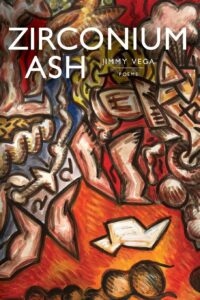
 Zirconium Ash by Jimmy Vega What Books Press
Zirconium Ash reads like a book written from inside the burn—after the ignition, after the damage, when the speaker is still warm with impact and fallout. Jimmy Vega’s poems move through freeway sprawl, bodily collapse, and spiritual exhaustion with a voice that is jagged but lucid, streetwise without posturing. The collection feels less like a performance of despair than a record of surviving it: a poetics of residue, of what’s left when the spectacle has passed and the body keeps score.
One of the book’s quiet strengths is its refusal to romanticize collapse. In “this is another freeway poem—”, Vega takes on one of the most exhausted American backdrops—the freeway—and somehow restores its menace. The poem isn’t about movement so much as stasis: the psychic deadlock of lanes that promise escape but deliver only repetition. The dash in the title feels earned; it signals interruption, an unfinished thought looping endlessly like traffic itself. Vega uses the freeway as an externalization of a mind caught between acceleration and paralysis, and the poem succeeds because it resists lyric prettiness. The concrete remains concrete.
That attention to the body’s limits sharpens in “collapsed lung,” one of the collection’s most physically alarming poems. Here, breath becomes the central metaphor, but Vega never lets it drift into abstraction. The poem stays close to pain, to the terror of involuntary shutdown. What’s striking is how restrained the language is—no melodrama, no flourish—just the steady recognition that the body can betray you without warning. It’s a poem about vulnerability that doesn’t ask for sympathy, which makes it all the more devastating.
If much of Zirconium Ash operates in the realm of damage, “nostalgia for samsara” turns toward a weary metaphysics. The title alone carries a heavy irony: longing not for enlightenment, but for the cycle itself. The poem suggests a speaker too tired for transcendence, attached to repetition because it’s familiar, survivable. Vega’s handling of Buddhist vocabulary avoids the trap of spiritual tourism; instead, he frames samsara as another system you can’t quite escape, no different from the freeway or the body. The poem hums with exhaustion rather than revelation.
The collection’s cultural references are sharp but never decorative. “sister ray” channels noise, duration, and psychic abrasion, echoing the Velvet Underground track not by imitation but by attitude. The poem feels abrasive in its pacing, willing to test the reader’s endurance. Vega understands that certain experiences—addiction, obsession, prolonged grief—can’t be rendered cleanly. The poem leans into that mess, letting repetition and pressure do the work.
Finally, “no fun / no love” distills the book’s emotional thesis with brutal efficiency. The slash is important: it’s not a choice but a pairing, two absences feeding each other. The poem reads like a verdict delivered after long deliberation, stripped of illusions. Yet even here, Vega avoids nihilism. There’s an honesty to the poem that feels hard-won, as if naming the lack is a step toward something like agency.
Taken together, Zirconium Ash is a collection that understands collapse as a condition, not a climax. Vega’s poems don’t seek redemption arcs or cathartic release; they sit with the damage and report back faithfully. The result is a book that feels necessary rather than ornamental—ash still warm, lungs still working, traffic still moving nowhere.
Zirconium Ash by Jimmy Vega is available for purchase at https://www.amazon.com/zirconium-ash-Jimmy-Vega/dp/B0FQRJXRRB/
While a resident of New York City, Richard Modiano became active in the literary community connected to the Poetry Project where he came to know Gregory Corso, Allen Ginsberg, Anne Waldman, William S. Burroughs and Ted Berrigan. In 2001 he was a programmer at Beyond Baroque Literary/Arts Center, joined the Board of Trustees in 2006, and from 2010 to 2019, he served as Executive Director. The Huffington Post named him as one of 200 people doing the most to promote poetry in the United States. Modiano is the winner of the 2022 Joe Hill Prize for labor poetry and is a Pushcart Prize nominee.