 Planting Stones to Teleport: A Conversation with Seance of the Bees author Andrea Rexilius
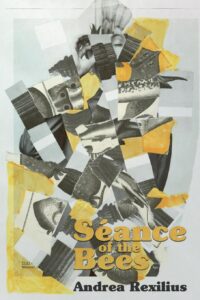
With her latest collection, Séance of the Bees, poet Andrea Rexilius has succeeded at what countless others have attempted, achieved a secure balance of realism and lyricism. She does this by carefully chosen ideas and words and syntax cueing sensory response and by creating her own form of call-and-response mosaic mazes. Séance of the Bees is full of lines that take root in the mind and blossom, and ideas like viruses in narrative, how cultural memes are conveyed, lines as veins and language as stitches hemmed like the hexagonal chambers of a beehive.
And something in the language pulsing
standing three stones deep in her under story
in her carrying forth of bodily imprint
Thus spoke plants and flowers
To her on every hill and hive (21)
Afterword (to a section called Structure of a Flower) on page 39 reminded me strongly of Kenneth Patchen, half-absurd abstraction full of truth, a list with lines like “A very light lemon self; a self of replication;” and “an over-examined self, a pale amethyst violent self with a pale yellow throat of wasps;”” and “a self of the ingrained self of sleeting” culminating with a payoff of “an avowed self; a self as new sentience.” She writes prose, too, from artistic evaluation of her own experiential craftwork to unrehearsed notes. “Vision: I am in a cavernous space with many other people. Being counted off, non-linearly, eight-hundred ninety-four, fifty-six, seven. We lie on the ground naked in the shape of a skull, Victorian tableau vivant in the hollows.” (49)
I asked her what she does to remove herself from unfavorable stimuli and Rexilius answered that she favors redirection of stress and bad news to the creative, and perception in active imagination. “Some friends and I performed a ritual to honor our childhood selves and my candle split, one part fell off and dripped in a circle around the base of the candle,” she told me when we met the other day.
“The two Andreas?” I supposed aloud. This author’s unknown life experience includes a sister with the same name who appears speaking a different language soon after her sense of self has formed, motivating the author to learn communication by instinct not by rote. And how could that not make a poet of her? How else might anyone’s nervous system process that kind of experience?
“Well—I interpreted the candle doing that as my current-self enacting a circle around my child self, protecting me.”
A few wisely chosen quotes epitomize the authorial intent of this collection. “Within any day there is a dimension both occult and common,” says Lisa Robinson before any page numbers and “Language is an ordering of reality,” says Lyn Hejinian (72), for example, and I was pleased to discover a reference to Patchen some pages later (91). In a nutshell, Séance of The Bees explores the relationship between selfhood and creative craft. “I know that’s the description,” demurs the author, sighing at the necessity of nutshell marketing to commerce when art is so much more. A central message in this book is that of selves doubling and mapping each other emotionally, a ritual incepted by the two Andreas and furthered by a partner’s temporary loss of the ability to communicate, its particulars nicely subsumed, and the book (in particular a section near the end called The Bees) features collage art by the author. “I use the scraps from what I’ve cut-up to trace/paint new lines/drawings onto the collage. I create in a series, until all the scraps are used.” (92)
“I used to live in a house where I could look out my window and there was a big forest there,” she tells me, relating the tale of a few stones planted for her future self in those woods as a girl and returned to as an adult in acknowledgement of her former self’s projection in a moment of absolute realness and equipoise. Rexilius is the author of four other books so far, including Sister Urn (Sidebrow, 2019) She is the Program Director for Regis University’s Mile High MFA in Creative Writing and teaches at the Poetry Collective at Lighthouse Writers Workshop in Denver, Colorado. “What I like about both of those programs is that my students are people with day jobs who took to writing on the side to deepen their lives, and it’s resulted in bringing a lot of creativity to their ordinary pursuits and created a lot of new things.”
 Zack Kopp is co-creator of the monthly Coffeehouse for Social Medicine at Mutiny Information Café in Englewood. All his books are available at Amazon. Find more of his writing (fact and fiction) at www.campelasticity.com