first published in the Scumrag by Scumbag Press in the UK
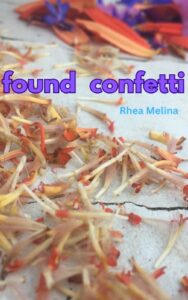 This is Why We Can’t Have Nice Things: Rhea Melina’s Found Confetti
(Carbonation Press, 2024)
“I beg of you to not get me wrong,
But you will”
I met Rhea Melina on Telegraph in Oakland, at a craft beer and bottle shop where we were an eclectic crew with flasked chartreuse herded from the alley for our leg of the Beast Crawl Lit Fest. She was new to our annual Collapse Press and Naked Bulb crowd but not new to performing, having flown in from out of state to rep with Bulb. We were curious about her.
In an interview in the book, she is described with a “quiet power” and her poetry “transcendent, near-prophetic.” She produced a trailing roll of paper, and jumped right in with a meandering set that became sharper as though we were adjusting her papers with a knob. All eyes were fixed, the room was quiet as she stirred up and peeled back on topics both beautiful and ugly.
What attracts me to Melina’s poetry is the vulnerable honesty and candid presentation of imperfection, her unapologetic “messiness of heart” and yearning for a world where we “take the collars off the dogs” and they stay because they want to. The world she wants is one of loving presence, not power’s coercion- and she knows a thing or two about coercion. This speaks to what she is trying to do as a poet, it seems, to share the process itself of trying and to make the case for the importance of that voice standing on its own, in quiet power, that doesn’t need anyone’s permission to simply be.
Liberation and choice in a society that wants to exert control and hierarchy- whether race or class or role- is a theme that we find in Found Confetti where dandelions and shoe piles collect and the distant condo dwellers have a view of the clothesline with their flapping fabrics on display far longer than they should be. In these ordinary acts, Melina’s poetry celebrates letting go of expectations and rules and the price of being a superficial kind of “tidy” that mirrors a longing that paradoxically yields so little to its remedies. In a poem about dog sitting, the poet tries to navigate being a guest in a “just so” house where the decorative pillows won’t take their places in the scene. In another, the poet expresses guilt over the possessions of a dead parent, being used instead of held apart in a space of enduring tribute. Physical items are to be used by people, but not allowed to govern people. Too often, possessions rule the living. (“happiness would not come from something that can be owned/although comfort assures security I/don’t need much to warm my hands”)
We don’t live to possess and control “stuff”. Our milestones don’t revolve around ownership, Melina reflects on chasing the trajectories of car, house, debt. In these poems, we see a poet who celebrates the feral, the real and flawed and messy ways we both live and often die. Nothing about these things are clean.
“when Chief Sealth said you will one day realize you/cannot eat money/
But now I see that if you could, you would/and you’d love how it would keep you skinny/ and how it’d taste like wasted time and nameless/ fingertips”
There seems to be this need within us to try to make them so, because we want to feel in control when we aren’t. These poems scream that lesson from the roof tops.
The poet has learned about security and our spaces, both safe and dangerous. We make choices to be safe, which are not the same as choices to be beautiful.
I like the way Melina weaves the living with the dead, the present with the past, honoring with grief. We meet believers and skeptics, haunters and the haunted, and people whose stories are both told and forgotten. (A family/void of trust and reality/a family/lost in concrete/where trees cannot reseed”) Melina explores race and identity, in shared conversations about ancestors and what it means to be lighter and darker skinned, and the best way to talk about it with a young child without introducing shame or bitterness- just the facts. But what are the facts?
The poems are real, dark, offering up a brave accounting of a past that brings lessons to each stop, where survival offers explanations to a forgiven self seeking reconciliation. Trauma is processed against the truth of society’s messy underbelly where exploitation and hunger bring the sheep to the wolves. What does freedom mean then, in that sense? Are we choosing from fair options?
The reader needs to decode the “Found Confetti” of Melina’s work for themselves. “I celebrate breathing/ throw whatever confetti I can find.”
“I found confetti
in the rubble
in my infected wounds
in my Self
It’s beautiful
Found Confetti by Rhea Melina is available at https://antiquatedfuture.com/books/found-confetti-by-rhea-melina/
Lynn Alexander is the co-host of The Friday Collapse series and author of Find Me in the Iris, who jumps into projects with both feet but sometimes lands on her ass.