Winner of the Brian Fugett Memorial Prize
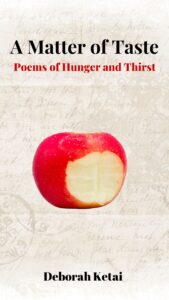
A Matter of Taste: Poems of Hunger and Thirst by Deborah Ketai
Citizens for Decent Literature Press 2026, Winner of the Brian Fugett Memorial Prize
Deborah Ketai’s A Matter of Taste is a collection obsessed—in the most productive sense—with appetite: for food, for sex, for meaning, for language, for life itself. Hunger is not merely a metaphor here; it is the governing physics of the book. From the cosmic ravenousness of “The great hunger” to the domestic ache of “All she wanted,” Ketai treats taste as both a sensory faculty and an ethical one: how we choose, consume, savor, or refuse the world.
The poems are unified less by narrative than by pressure. Again and again, Ketai presses bodily experience — eating, swallowing, choking, burning, digesting — against intellectual and emotional states. Mental illness, especially bipolar disorder, is rendered not abstractly but somatically. In poems like “Bipolar, too” and “Lithium Lament,” mania and medication are tasted, craved, resisted. The speaker mourns the loss of intensity even while acknowledging its danger, asking not for a cure but for a “middle road,” a way to live without erasing desire. These poems refuse the tidy arc of recovery narratives; instead, they honor ambivalence as a form of truth.
What distinguishes Ketai’s work is its tonal range. She moves fluently between the cosmic and the comic, the erotic and the elegiac. A poem like “Descent into the maelstrom” is unabashedly sensual, while “Vin ordinaire” delivers a sharp, almost essayistic critique of linguistic inflation and emotional exaggeration. Elsewhere, domestic scenes — gardening, cooking, family dinners — become sites of myth-making. “World builder,” one of the collection’s standouts, casts maternal labor as ecological creation, collapsing the distance between making crepes and sustaining galaxies. The poem’s breathless abundance mirrors its subject: care as generative force.
Food imagery anchors the book, but it never becomes gimmick. Hunger is political (“The smelting pot”), ecological (“Drought”), relational (“Rashomon”), and spiritual (“An older woman considers prayer”). Even God is undone by appetite in “On the eighth day,” a darkly playful poem that turns creation into self-consumption. Throughout, Ketai resists sentimentality. Grief, particularly for the mother figure who looms large in the collection, is rendered with bite rather than balm. “A Thanksgiving letter to Mom” captures mourning as a hollow fullness—too much food, not enough presence—while refusing easy consolation.
Formally, Ketai is adventurous without being showy. She uses free verse, prose poetry, enjambment, and compression to suit the emotional logic of each piece. Her language is tactile and precise; she trusts specificity over abstraction. Even when the poems veer toward the surreal or grotesque (“That’s my story, and I’m sticking to it”), they remain grounded in felt experience, in the body as the final arbiter of truth.
A Matter of Taste is not a comfortable book, nor should it be. It asks readers to examine what they hunger for, what they consume unthinkingly, and what they can no longer stomach. Yet it is also deeply alive, animated by curiosity, humor, and a fierce insistence on engagement. Ketai’s poems do not seek to resolve appetite; they honor it as the engine of thought and feeling. In doing so, they offer not satiety, but something better: a sharpened sense of what it means to be alive and wanting.
A Matter of Taste: Poems of Hunger and Thirst by Deborah Ketai is available for purchase HERE
While a resident of New York City, Richard Modiano became active in the literary community connected to the Poetry Project where he came to know Gregory Corso, Allen Ginsberg, Anne Waldman, William S. Burroughs and Ted Berrigan. In 2001 he was a programmer at Beyond Baroque Literary/Arts Center, joined the Board of Trustees in 2006, and from 2010 to 2019, he served as Executive Director. The Huffington Post named him as one of 200 people doing the most to promote poetry in the United States. Modiano is the winner of the 2022 Joe Hill Prize for labor poetry and is a Pushcart Prize nominee.