A Series of Replays: Pella Felton reviews Apostasies by Holli Carrell
Carrell, Holli (2025) Apostasies (Poetry Collection). Perugia Press.
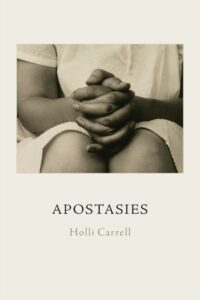
Apostasies reads like a history lesson wrapped in a memory play. Salt Lake City native Holli Carrell’s ambitious collection presents a thorough, personal study of structural gender violence in the Mormon church. Carrell alternates between a dialogic interrogation of the structural misogyny and predation within the Mormon movement and searingly specific memories of moments where that ideology was branded onto her body. Throughout the collection, Carrell positions the reader at just the right angle to peer through a window into the problem which lacks not merely a name, but a voice with which to speak it. The result is an accomplished piece of feminist scholarship—Apostasies is the single best piece of literature I read, from any genre, in 2025.
The brilliance of this volume comes from Carrell’s relentless imprinting of her formative trauma onto the architecture and phenomenology of the collection’s poems. With so much of the collection focused on the structure of oppression in the church, it makes sense that the book’s visual and structural form would mirror Carrell’s personal experiences of Mormonism’s gendered discipline. Carrell dispatches audacious and complicated visual layouts to give spatial presence to these oppressions.
In “Womanhede,” Carrell illustrates the patriarchal pedagogy of the Mormon church through creative indentation. Lines remaining to the left represent laws (“The flock always watches,” “Appropriate underclothes”). Indentations force everything else farther down the hierarchy of the document, forging a submissive relationship between the female subjects and the foregrounded commands. This visual taxonomy of discipline forces its lyric voice so far to the right that it quickly loses its sovereignty to the edge of the page. The lives of the women are pushed two or three indentations deep at times, finally exploding into a puddle of “Yes” far into the right orientation of the page, giving presence to the means through which the women are hailed as servants .
“Logophobia,” l manifests the fear of outside knowledge as cascading piles of textual surveillance. Carrell quarantines verses into two discrete, alternating columns of no more than five words. This formatting orients the reader towards an isolated, claustrophobic relationship with the text, reinforcing a paranoia of outside knowledge. This sterile, dissociative effect reminds readers that suppression of thought begins with a concentrated effort to alienate the reader from the words that create the building blocks of thought itself.
Prose poems in the collection (“We Won’t Discuss This,” “Garments”) often represent more unresolved traumas—solid blocks of memory that cannot move. However, my absolute favorite poem in the collection is “The Question of She,” which uses an almost formless, unbroken five lines of text with no formatting or punctuation. Carrell’s repetition of “her” and “I” presents both an interrogation and an escape from the rigid constraints placed on gender. This is a poem that forces the reader to construct their own semantic meaning, allowing for a profoundly fluid interpretation of what is being said here (exactly the way all gender should be constructed).
The undeniable heart of this collection is “Patterns,” a massive 28-page hybrid lyric essay. This document provides an unapologetic reckoning with the alleged crimes and predations of Mormonism’s founding saint, Joseph Smith. The burying of this excavation in the middle of the text ironically mirrors Smith’s own mythical buried tablets, yet encompasses a much stronger, more rigorous rhetorical underpinning. “Patterns” operates as a separate text with its own embedded codec. Here, Carrell makes a strong, uncompromising case for Smith’s historical record as a sexual predator. By manifesting the tactics of grooming and violation through historical records, psychiatric research, and the visual erasure of her own childhood journals, Carrell prophesies a blandishment buried deeper in the psyche of Smith’s followers than any tablets.
Yet Carrell refuses to feed his delusion. The collection’s most terrifying moments come from documenting the tangible impact of Smith’s sexual politics onto Carrell’s own body. Poems like “Exhibit” and “First Sex” echo a series of violent replays where the scripts of “Womanhede” and “Patterns” force Carrell to reperform her role in a cycle of abuse. “Exhibit” documents a horrific incident where her physical deference to men was so standardized that she barely registered a moment of intimate partner violence (casual strangulation), treating it as being mundane: “as a mother’s command, her hands / twisting and plaiting my hair” .
In “First Sex,” Carrell uses the specific, domestic vocabulary of her upbringing to render familiar the inevitable lack of agency she experiences inside a small tent: “That I had a right to desire, / I did not understand. / All I knew was to lie / there like a grub” . This metaphor synthesizes the images and ideas of the whole collection into one heartbreaking moment of gestus—if left unchecked, the strictures of submission and predation documented in “Patterns” will eventually reduce every woman’s body to something small, disgusting, and crushable.
It is in these moments of utter devastation that Apostasies performs its most vital critical work: giving presence to a trauma so normalized that it is barely legible to those enduring it. Holli Carrell transforms these ancient histories from being merely “wounded attachments”—static scars of identity—into “wounded vibrations.” She makes the pain visible as such, forcing the reader to feel the deep and tragic resonances of corporeal and spiritual repression. But these vibrations transcend the Mormon Church. Apostasies arrives as a terrifying prophecy for the repressive gender politics of our current moment, where political zealots’s exploit their authority and power to gender and sexualize the bodies of children, even as we discover more links to their systematic predation of young women (often with the same levels of redaction and blackout poetry as Carrell’s journals.) Still, she turns this sad revelation into a call for action. We have already been pushed so far to the margins that we must fight tooth and nail to stay on the page. In this precarious space, Apostasies honors the parts of us that refused to fully disappear into the white space. Carrell’s vibration has transcended its history to become a full tremor, shaking the memories of all who encounter her wounds.?– {pf}
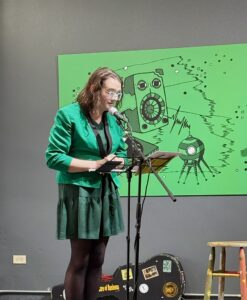 Pella Felton is a poet, performer, and independent scholar stationed out of Northwest Ohio. She holds a certificate in Performance Studies from Bowling Green University and has performed her work at various poetry festivals and events throughout the Midwest including the Toledo Fringe Festival, BGSU Winter Wheat Literary Festival, and the Literary Underground Festival. She is also an accomplished media and performance scholar who frequently presents her research at conferences such as the Pacific Ancient and Modern Language Association, The Great Lakes Association of Sound Studies, and the Society for Media and Cinema Studies. Pella lives in Bowling Green, Ohio.