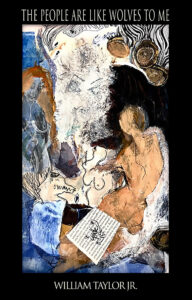
 The People Are Like Wolves to Me by William Taylor Jr.
William Taylor Jr.’s The People Are Like Wolves to Me (Roadside Press) is a book steeped in the wreckage and radiance of contemporary life—an unvarnished, booze-stained hymn to the broken, the searching, and the almost-resigned. The collection reads like a long walk through San Francisco at dusk: the bars breathing their neon sighs, the alleyways humming with ghosts, the fog settling like an old sorrow you’ve learned, finally, to wear with a kind of dignity.
Taylor continues his project of blending the quotidian with the existential, but in this volume the scale feels grander, the ache more distilled. These poems arise from dive bars, sidewalks, record stores, and museum galleries—yet everything he touches becomes charged with mortality, with that familiar Taylor preoccupation: the limits of art and the limitlessness of loss.
He works in a voice that is direct and unpretentious, a conversational lyricism sharpened by gallows humor and a self-deprecating honesty. In poem after poem, he captures the feeling of being alive in a century that seems as though it’s collapsing under the weight of its own absurdity. The 21st century like a final curse from a vengeful dying god is both hyperbolic and perfectly accurate in the world this book inhabits.
The collection’s geography—with its bars on Grant, Polk, Larkin; its Tenderloin nights; its churches of beer and jukebox—feels as important as its themes. Taylor is a cartographer of North Beach melancholy, drawing out the dignity and desperation of the people who hover at its edges: the bartenders who double as oracles, junkies whose laughter becomes accidental art, the poets who talk too much and write too little. These figures populate the poems not as symbols but as fellow travelers through the long emergency of living.
One of Taylor’s great gifts is his ability to write about despair without glamorizing it, to gesture toward redemption without promising it. The poems know beauty, but they never insist on it; they know suffering, but they don’t worship it. Instead, the book offers a kind of modest grace: make a music even of this, he writes—and the collection itself is evidence that he can.
Loss threads through the book—personal loss, artistic loss, the erosion of cities and friendships and ideals. Yet there’s a surprising amount of tenderness: the Christmas lights left up as a charm against the void, the bartender whose tears transform a street corner into a moment of communion, the quiet hope that some poem, somewhere, might be the one that turns the lock. Even the wolves of the title are less monsters than metaphors for the hunger that drives us all.
At its heart, The People Are Like Wolves to Me is a meditation on persistence: why we write, why we drink, why we fall in love with impossible people, why we stagger through the days even when the sky gives us no reason to believe it will brighten. The book knows, deeply, the strange human longing to be remembered by a universe that does not keep books.
Yet Taylor insists that the noticing matters. The poems are themselves a plea: Let it not be stricken from the record. They are an act of witness—of the city, of the broken-hearted, of the poet himself.
This collection is not merely a record of contemporary despair; it is a testament to the stubborn spark that remains in the ashes. It’s a book for anyone who has ever felt like a ghost in their own life, for anyone who finds themselves looking for a little light in the long corridors of the city, for anyone who has ever tried to “shake it off” with a poem, a drink, or the sight of a stranger’s beautiful coat on a cold night.
Taylor reminds us—with humor, with bitterness, with bruised affection—that even if the world forgets our names, there is still the small salvation of seeing and being seen. And in that way, this book does precisely what it hopes the universe might do: it remembers.
The People Are Like Wolves to Me by William Taylor Jr. is available most places books are sold. Get it from the publisher at https://www.magicaljeep.com/product/wolves/ZAK3WRXRVGBUFCNYFNYDVCFG
While a resident of New York City, Richard Modiano became active in the literary community connected to the Poetry Project where he came to know Gregory Corso, Allen Ginsberg, Anne Waldman, William S. Burroughs and Ted Berrigan. In 2001 he was a programmer at Beyond Baroque Literary/Arts Center, joined the Board of Trustees in 2006, and from 2010 to 2019, he served as Executive Director. The Huffington Post named him as one of 200 people doing the most to promote poetry in the United States. Modiano is the winner of the 2022 Joe Hill Prize for labor poetry and is a Pushcart Prize nominee.