 The Bitter and the Sweet: Juanita Kirton’s Charred Sugar in My Bones
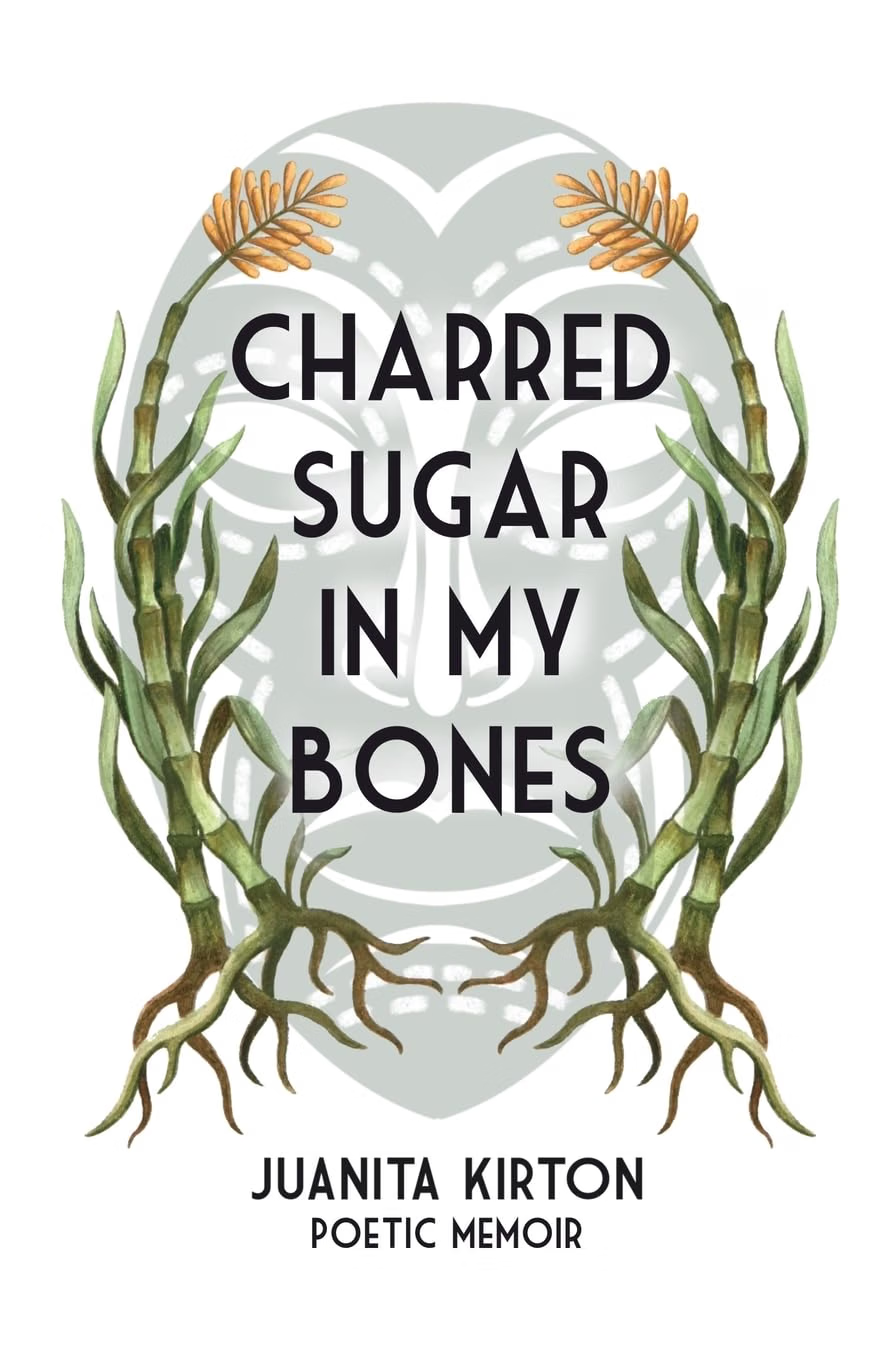
Charred Sugar in My Bones: Poetic Memoir, by Juanita Kirton. Pink Trees Press, 2026.
Memory is both a source of nourishment and a repository of pain in Juanita Kirton’s Charred Sugar in My Bones, a remarkable poetic memoir that moves between the Caribbean and Brooklyn, childhood and old age, military service and domestic intimacy, personal trauma and collective history. Kirton’s achievement lies in her ability to make these seemingly disparate experiences part of a coherent emotional landscape without reducing the contradictions that give her life its complexity. Her poems confront the devastating consequences of childhood sexual abuse, the complicated loyalties of family, the ravages of memory loss, and the struggle to claim an identity unconfined by race, gender, or conventional expectations. Yet this is also a book filled with humor, sensual pleasure, adventure, and love.
The collection takes its organizing principle from the structure of a meal. Divided into “Starters,” “Main Course,” and “Dessert,” and followed by a section of family recipes, the book makes food both a metaphor for experience and a tangible connection to the past. Kirton’s memories are inseparable from the flavors and aromas of her Barbadian heritage: flying fish, cou-cou, codfish cakes, bakes, sorrel, mauby, and the sugarcane that becomes the collection’s central image. Food sustains the family, preserves cultural identity, and carries memories across generations. But sweetness is never uncomplicated. Sugar can burn, and what nourishes can also conceal suffering.
The title poem, “Sugar,” establishes the book’s principal tensions. Kirton describes herself as a product of Caribbean ancestry and Brooklyn streets, a woman whose identity refuses the categories imposed upon her:
I’m from Brooklyn pavements
fused with island blood hyphenated
Afro-American-Caribbean
no check box
The insistence on a hybrid identity is immediately complicated by memories of domestic violation. The poem moves from the pleasures of childhood to the discovery that the family home harbors a dangerous secret. Kirton writes of “childhood interrupted,” of a father who abuses and a mother whose silence becomes part of the emotional architecture of the household. The poem’s final return to the image of charred sugar suggests that experience cannot be separated into its pleasant and painful components. Both have entered the body, becoming inseparable from the self.
Kirton’s treatment of childhood trauma is particularly effective because she refuses to simplify the people involved. Her father is simultaneously a source of affection, instruction, and terror. In “Old Stone,” she recalls a man who taught her to swim, drive, and maintain a car, while acknowledging his betrayal of the trust upon which those memories depended. The poem’s emotional force emerges from the impossibility of reconciling these versions of the same person. Rather than offering an easy resolution, Kirton permits the contradiction to remain unresolved.
Equally complicated is her portrait of her mother, affectionately called Mum-mee, to whom the collection is dedicated. A gifted seamstress, accomplished cook, pianist, and devoted parent, Mum-mee emerges as one of the book’s most vivid presences. Her creative abilities provide the household with beauty and order, even as that order conceals its darker realities. Kirton’s reflections on her mother are marked by admiration, longing, resentment, and the painful recognition of how much remained unspoken between them.
The poems about Mum-mee’s cognitive decline are among the collection’s most moving. In “What You Forgot,” the piano becomes a repository of identity, its music recalling a woman whose memories gradually disappear. Kirton’s language moves between musical imagery and the humiliating practical details of physical and mental deterioration. The instrument that once animated the household remains after its player can no longer summon the music. The poem becomes an elegy not only for the mother but also for the shared experiences that vanish with her.
In “Sometimes,” Kirton recounts a frightening drive along Interstate 95 during which her confused mother opens the passenger door while the car is traveling at highway speed. The episode is narrated with almost unbearable immediacy. Yet its conclusion offers a moment of grace: mother and daughter sing a familiar hymn together, and for a brief interval, memory and recognition return. Kirton does not sentimentalize the episode. The danger remains real, and the reprieve is temporary. Its poignancy comes from the fragility of the connection.
These poems suggest that memory is not simply a record of what has happened but a form of relationship. To remember someone is to preserve a connection that time, illness, and death threaten to dissolve. Kirton’s writing becomes an act of retrieval, an effort to recover the voices and gestures of people who might otherwise disappear.
The collection’s middle section expands beyond the family to examine Kirton’s experiences as a motorcyclist, soldier, and politically engaged Black woman. These poems introduce a more assertive voice, one determined to exercise the freedom that childhood denied her. In “I Don’t Do the Ordinary,” Kirton describes learning to ride a motorcycle at forty-one, the oldest student, the only woman, and the only person of color in a class of twenty-five. The poem’s account of mechanical coordination, anxiety, and eventual triumph transforms the motorcycle into an emblem of self-determination.
In “I Soar” and “Blue Motorcycle,” the open road offers a physical expression of liberation. The imagery is kinetic, filled with asphalt, wind, landscapes, and the exhilaration of speed. These poems provide a welcome counterweight to the enclosed spaces of the childhood poems, where closets, bedrooms, and family houses become sites of confinement. On the motorcycle, Kirton moves through a world of possibilities rather than restrictions. The contrast is especially powerful because the freedom she describes is neither abstract nor easily achieved. It requires discipline, risk, and the willingness to confront fear.
Her military poems complicate this celebration of independence. “Uniform Basic” captures the regimented physical demands of military training through clipped phrases, repeated commands, and the relentless accumulation of bodily discomfort. In “A Soldier’s Song,” the perspective broadens to encompass the human costs of war. The poem’s images of wounded bodies, damaged landscapes, and interrupted family lives challenge patriotic abstractions with the material realities of violence. “Nike Shoes” is particularly striking in its use of discarded footwear as evidence of war’s indiscriminate destruction. Here, Kirton’s language is economical and unsparing.
The political poems extend her personal concerns into a larger historical context. “Dear Aunt Jemima” examines the racist commercial imagery that entered American households under the guise of familiarity and domestic comfort. The poem is especially resonant in a collection so deeply concerned with food, maternal labor, and the transmission of cultural memory. Kirton interrogates the transformation of Black women’s labor into a reassuring commodity, exposing the historical violence concealed beneath a smiling advertising image.
“For Phillis,” addressed to the enslaved poet Phillis Wheatley, situates Kirton’s own literary practice within a history of Black women struggling to speak under conditions designed to silence them. “The Table” similarly transforms an ordinary household object into a witness to enslavement, exploitation, survival, and emancipation. These poems establish an important continuity between the private trauma explored earlier in the book and the collective injuries of American history. In both cases, the struggle is over who controls the narrative, whose suffering is acknowledged, and whose voice is permitted to endure.
Kirton’s poetry is often most effective when it combines concrete detail with emotional restraint. The childhood prose pieces “Winter Promise” and “Fall Skates,” for example, are memorable for their affectionate portraits of her grandfather. A nighttime expedition through a snowbound Brooklyn neighborhood for chocolate ice cream becomes a small but luminous act of love. In “Fall Skates,” her grandfather replaces a cherished pair of roller skates stolen by an older boy. These episodes demonstrate that tenderness, like trauma, can leave a permanent imprint upon memory.
The book’s formal variety is both a strength and, occasionally, a limitation. Kirton moves freely between lyric poetry, prose memoir, documentary testimony, political address, and narrative recollection. Her diction shifts from intimate confession to colloquial humor, from incantatory repetition to blunt confrontation. This flexibility reflects the many identities she inhabits, but it also produces an unevenness of poetic intensity. Some passages explain emotions that the imagery has already communicated, while certain political poems lean toward declaration rather than discovery. At times, the accumulation of subjects and experiences threatens to overwhelm the collection’s organizing structure.
Nevertheless, this expansiveness is central to Kirton’s project. She is not attempting to construct a polished, linear account of personal development. Instead, she presents a life as it is actually remembered: through recurring images, sudden associations, unresolved conflicts, and unexpected moments of revelation. The photographs interspersed throughout the book deepen this effect. Images of Mum-mee, her grandfather, childhood clothing, motorcycles, and military service give the poems a documentary dimension. They also remind the reader that the people and events under examination belong to a particular family history, even as the poems reach toward broader questions of identity and survival.
The final section, “Dessert,” turns toward sexuality, aging, intimacy, and the possibility of reconciliation with the self. But Kirton resists the expectation that dessert must be uniformly sweet. “Salt and Pepper” considers the bodily changes and shifting desires that accompany aging, while “Deliciously Defiant” celebrates erotic experience with an exuberance that refuses shame. The latter poem is especially important because it places female desire at the center of a life that has so often been shaped by the desires and demands of others.
In “Just Carol,” Kirton offers a portrait of intimacy grounded in mutual recognition and emotional security. The poem’s sensual language is also the language of healing, suggesting that love can provide a space in which the fragmented self becomes whole without surrendering its autonomy. It is significant that the collection’s movement toward affirmation occurs not through forgetting past injuries but through the discovery of relationships that allow vulnerability without fear.
Yet Kirton does not offer a simple narrative of redemption. The closing poems remain alert to mortality, uncertainty, and the unfinished work of self-understanding. In “Knowing,” she confronts the indignities and surprises of growing older with characteristic irreverence, arriving at the recognition that “wisdom is living with the unknown.” Such moments distinguish her writing from the conventional rhetoric of triumph over adversity. Survival does not guarantee certainty, and healing does not erase the past.
The concluding recipes provide an unexpectedly moving coda. Instructions for cou-cou, codfish cakes, coconut bread, bakes, and other family dishes transform the book from a record of personal experience into an archive of cultural inheritance. These recipes are not merely decorative additions. They preserve the practices through which love was expressed, family identity maintained, and connections to the Caribbean sustained across generations. In a collection haunted by the disappearance of memory, the recipes offer something that can be recreated and shared. They allow the reader, quite literally, to participate in the preservation of a family history.
This gesture also returns us to the central paradox of the title. Sugar is transformed by heat, its sweetness darkened but not entirely destroyed. Likewise, Kirton’s life has been shaped by experiences that cannot be undone, yet those experiences have not exhausted her capacity for pleasure, creativity, or love. The poems do not suggest that suffering is necessary for wisdom or that trauma is somehow redeemed by artistic achievement. Rather, they insist upon the human capacity to create meaning without denying the damage that has occurred.
In the collection’s acknowledgments, Kirton honors a lineage of Black women writers that includes Audre Lorde, June Jordan, Pat Parker, Sonia Sanchez, Nikki Giovanni, and Toni Morrison. Their influence is evident in her insistence that the personal is inseparable from the political, that the body is a legitimate site of knowledge, and that the act of speaking can itself constitute resistance. Yet Kirton’s voice remains distinctly her own, shaped by Caribbean family traditions, Brooklyn working-class life, military discipline, queer desire, and the pleasures of the open road.
Ultimately, Charred Sugar in My Bones is a book about the difficult work of remembering and the equally difficult work of loving oneself. Its emotional center may be found in “Stranger,” where Kirton contemplates the possibility of recognizing and embracing the person she has become. The question is not answered once and for all. Instead, the entire collection becomes an extended response, assembled from the fragments of a life that refuses to be defined by its wounds.
Juanita Kirton has written a courageous, sensuous, and deeply personal book. Its greatest accomplishment is not simply that it bears witness to suffering, but that it makes room for the full abundance of experience: grief and laughter, anger and tenderness, desire and disappointment, the bitter and the sweet. In the end, Charred Sugar in My Bones reminds us that memory is not only what we carry. It is also what we choose to preserve, transform, and pass on.
While a resident of New York City, Richard Modiano became active in the literary community connected to the Poetry Project where he came to know Gregory Corso, Allen Ginsberg, Anne Waldman, William S. Burroughs and Ted Berrigan. In 2001 he was a programmer at Beyond Baroque Literary/Arts Center, joined the Board of Trustees in 2006, and from 2010 to 2019, he served as Executive Director. The Huffington Post named him as one of 200 people doing the most to promote poetry in the United States. Modiano is the winner of the 2022 Joe Hill Prize for labor poetry and is a Pushcart Prize nominee.