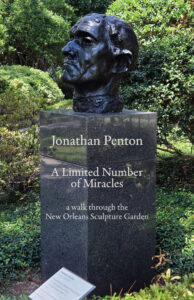
 A Limited Number of Miracles by Jonathan Penton
Jonathan Penton’s A Limited Number of Miracles from Lavender Ink is an ambitious, deeply personal, and intellectually demanding collection that transforms a walk through the Sydney and Walda Besthoff Sculpture Garden in New Orleans into a meditation on grief, memory, art, and the limits of language. Structured as sixty-six ekphrastic poems, each responding to a sculpture in the garden, the collection initially appears to belong to a venerable poetic tradition. Yet Penton steadily subverts the expectations of ekphrasis. Rather than describing works of art, he uses them as catalysts for emotional and philosophical inquiry, allowing sculpture to become a mirror for psychological landscapes rather than visual objects.
The book’s emotional center lies in the death of the poet’s daughter, Michaela, whose suicide during the manuscript’s long gestation fundamentally altered its trajectory. Penton explains in his introduction that the project began years before her death as a straightforward exploration of the sculpture garden but gradually became the vessel through which he processed overwhelming grief. That admission reshapes the reader’s understanding of nearly every subsequent poem. The sculptures cease to function as subjects and instead become occasions for mourning, self-interrogation, and existential reckoning.
One of the collection’s greatest strengths is its refusal to sentimentalize either grief or art. Penton consistently rejects easy consolations. In poems such as “Karma,” “Cosmos,” and “Gran Val de Grâce,” suffering is neither redeemed nor explained. The universe offers no reassuring moral architecture; bad things happen without cosmic justice. This philosophical skepticism gives the collection unusual weight, allowing it to avoid the therapeutic platitudes that often weaken contemporary elegiac writing.
Stylistically, the poems are remarkably varied. Penton shifts effortlessly between lyric meditation, dramatic monologue, prose poetry, fractured typography, satire, autobiography, and philosophical reflection. Some poems inhabit the voices of sculptures themselves; others become memoirs, conversations, or confessions only tangentially connected to their artistic prompts. This formal restlessness mirrors the physical experience of wandering through a sculpture garden, where each work demands a different mode of attention.
The collection is also notable for its intellectual density. Penton’s references range comfortably across classical mythology, theology, queer identity, popular culture, philosophy, psychiatry, contemporary politics, and literary history. Buffy the Vampire Slayer appears alongside René Magritte; Mardi Gras beads coexist with Greek tragedy. Rather than feeling eclectic for its own sake, these references accumulate into a distinctive poetic consciousness that refuses to separate high culture from lived experience.
At times this density becomes the book’s greatest challenge. Penton himself acknowledges in his introduction that the work privileges ideas over imagery, and many readers will likely agree. The poems frequently leap associatively rather than narratively, requiring readers to participate actively in constructing meaning. The emotional force remains undeniable, but some pieces feel intentionally opaque, their abstractions occasionally distancing the reader just as intimacy begins to emerge. Readers seeking vivid visual descriptions of sculpture may initially be surprised by how little attention many poems actually pay to the physical artworks themselves.
Yet this very refusal becomes one of the collection’s most original achievements. Penton demonstrates that ekphrastic poetry need not merely translate visual art into words; it can instead record the unpredictable psychological encounter between viewer and object. The sculptures become emotional tuning forks, vibrating with whatever grief, anxiety, desire, or memory the speaker brings to them. In this sense, the garden itself becomes a kind of therapeutic landscape — not one that heals, but one that permits sustained contemplation.
Perhaps the book’s most impressive accomplishment is its cumulative architecture. Individual poems vary considerably in tone and accessibility, but together they create an unmistakable emotional progression. The later poems, particularly those written after Michaela’s death, gather extraordinary momentum. References to suicide, parenthood, mortality, and failed consolation recur with increasing insistence until the closing poems achieve a devastating clarity. The final sequence feels less like arriving at answers than exhausting the available questions.
A Limited Number of Miracles is not an easy collection, nor does it aspire to be. It demands patience, rereading, and a willingness to inhabit uncertainty. But readers prepared to meet it on those terms will discover a work of remarkable emotional honesty and formal ambition. Penton has produced something that is simultaneously an elegy, a philosophical inquiry, a meditation on sculpture, and a portrait of New Orleans as a city where beauty and sorrow exist in perpetual conversation.
In an era when much contemporary poetry prizes immediate accessibility, A Limited Number of Miracles insists instead upon complexity, contradiction, and sustained attention. It is a challenging book, but also a rewarding one—a collection that ultimately suggests that while miracles may indeed be limited, art remains one of the few places where grief can be given enduring form.
A Limited Number of Miracles by Jonathan Penton is available at https://asterismbooks.com/product/a-limited-number-of-miracles
While a resident of New York City, Richard Modiano became active in the literary community connected to the Poetry Project where he came to know Gregory Corso, Allen Ginsberg, Anne Waldman, William S. Burroughs and Ted Berrigan. In 2001 he was a programmer at Beyond Baroque Literary/Arts Center, joined the Board of Trustees in 2006, and from 2010 to 2019, he served as Executive Director. The Huffington Post named him as one of 200 people doing the most to promote poetry in the United States. Modiano is the winner of the 2022 Joe Hill Prize for labor poetry and is a Pushcart Prize nominee.