 Before Words, Into Light
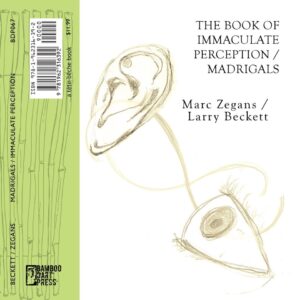
The Book of Immaculate Perception / Madrigals by Marc Zegans and Larry Beckett (Bamboo Dart Press)
There is a lovely impossibility at the heart of The Book of Immaculate Perception / Madrigals: two poets attempt, using words, to recover a condition that exists before words. Marc Zegans and Larry Beckett approach that impossibility from opposite directions. Zegans imagines consciousness emerging into distinction and language; Beckett, addressing his daughter, follows conception, birth, infancy, and childhood through the sensuous particulars of remembered life. Bound together tete-beche by Bamboo Dart Press—two books meeting back-to-back—the collections become more than companions. They read as two ways of asking the same question: what was the world before we knew what to call it?
The physical construction is significant. There is no conventional front and back. One can begin with Beckett, turn the volume over, and arrive at Zegans, or reverse the journey. The cover artwork by Dennis Callaci reinforces this reciprocity: two spare, almost embryonic forms seem connected across the book’s white field. Marc Zegans designed the volume, with layout by Mark Givens, and the result makes the object itself part of the argument. Each poet appears to be looking toward the other across the mysterious interval between sensation and speech.
Zegans’s The Book of Immaculate Perception is the more explicitly philosophical half. Its nine numbered poems trace an arc from prenatal sensation toward the acquisition of categories and language and, finally, toward an old man’s desire to recover the immediacy that language displaced. The opening poem gives us no infant psychology in the ordinary sense because, as Zegans conceives it, there is not yet a sufficiently differentiated self to possess one. There is instead red, yellow, buoyancy, fluid, muffled sensation: “Perception immaculate, yet to be.”
The phrase “immaculate perception” is both playful and serious. Perception is immaculate precisely because it has not yet been handled by language. Zegans is interested in the gradual contamination—or enrichment, since the book is too intelligent to make the matter entirely one-sided—of raw experience by distinction. Grey emerges between black and white; fuzzy fields acquire shapes; objects become this rather than that. The great metaphysical division arrives when the undifferentiated field begins to separate into self and world: “There is not a they, nor is there an I,” the narrator tells us, even as the poem recognizes that such distinctions will eventually be made by words.
Zegans handles these enormous subjects with appealing modesty. The poems are short, lucid, sometimes funny. Peekaboo becomes an ontological experiment: a towel rises, a face vanishes; the towel drops and existence returns. Crawling out of a crib becomes an encounter with a larger universe whose astonishing colors are visible before their names are available. Philosophy here is not imposed upon childhood from above. It grows out of the ordinary astonishments of infancy.
That makes the eighth poem especially consequential. By now the child has arrived at a condition in which “Nothing stands for anything; it just is.” For a moment the world appears without “the filtering of names”; then comes the devastatingly simple reversal: “And then words come and take it all away.”
Of course, this complaint is made of words. Zegans knows the paradox and makes it the engine of the sequence. Poetry is implicated in the loss it mourns. The poet cannot give us unmediated light; he can only arrange language so precisely that we become conscious of the distance between the word light and light itself. In the final poem the perspective suddenly lengthens across a lifetime. The narrator is now old, his head burdened with “words, concepts, and ideas,” still trying to return to “the grace of immaculate perception.” Yet the poem ends not in defeat but illumination: “Old now, again, there is nothing but light.” The circularity is important. Infancy and age touch.
Beckett’s Madrigals makes the complementary journey. These poems, written between 1997 and 2006, are addressed to his daughter Susannah and move “from conception on,” as Beckett explains in his author note. If Zegans approaches early consciousness speculatively, from inside an imagined developing awareness, Beckett approaches it through the ardent attention of a father.
His first poem begins before birth, amid moon, skin, sex, cycle, egg and sunrise. From there the sequence proceeds not as conventional narrative but as flashes of sensation and recollection. Beckett’s syntax is compressed, elliptical and musical. Articles disappear. Grammar bends. Images touch and separate rapidly. In one of the most striking poems, language itself seems to regress toward infancy:
“Oh ah
a the long rain flying bow
reachhand”
Soon come “empty belly,” “mama,” “milk,” “mirror,” “lightdaddy” and, finally, the marvelous description of the father as “storying, in your world before words.”
That phrase could stand as an epigraph for the entire double collection. Beckett is storying the prelinguistic world even as Zegans is attempting to think his way back into it.
Yet Beckett’s poems differ crucially in temperature. Zegans is contemplative, probing the relationship between perception and concept. Beckett is tactile, erotic, paternal. His world has breasts, milk, hands, flowers, horses, earth, breath and weather. A child’s experience arrives surrounded by adult love. One madrigal moves from stars to the sounds of lovemaking and then opens suddenly into an extravagant catalogue of flowers—”lilacs, larkspur, daisies, dogwood, / white asters, azaleas, irises, roses.” Another gives us the child on her first horse, holding its black mane while her mother steadies her and her father leads her across uneven ground. These are small scenes, but Beckett’s compression gives them the brightness of foundational myths.
The strongest link between the poets may be their shared understanding of sight as an act of creation. Zegans’s infant sees colors before possessing their names. Beckett ends his sequence with a child looking at an image of a horse on television. Asked whether she wants it, she caresses the image, cups her hands and replies, “I already have it,” while “your eyes light, inventing blue.” It is an exquisite ending because possession here has nothing to do with ownership. To see imaginatively is already to have. The child’s consciousness makes the world anew.
This is where the two books finally complicate their apparent distrust of language. Words may indeed “take it all away,” as Zegans writes, but these poems demonstrate the opposite possibility as well. Words can return something. They cannot restore infancy, prenatal perception, the first encounter with color, a daughter’s first horse, or the instant before an object had a name. But through rhythm, compression, image and syntax, they can make us feel the strangeness those moments once possessed.
The poets arrive there by notably different means. Zegans strips his poems toward propositions and paradoxes; Beckett breaks syntax toward music. Zegans asks what happens when consciousness acquires categories. Beckett asks what love remembers when it looks backward toward beginnings. One gives us the phenomenology of becoming a self; the other gives us the intimate witness of someone watching a self come into being.
The tete-beche format therefore is less like a publishing novelty than the necessary shape of the work. Neither collection quite completes its thought without the other. Parent faces child; age faces infancy; language faces the wordless; recollection faces first perception. Even the chronological directions cross: Beckett moves outward from conception into childhood, while Zegans ultimately bends the long accumulation of consciousness back toward the original condition of light.
The advance responses included in the volume repeatedly recognize this shared territory, describing the poems as occupying the cusp between “being and becoming” and as broadcasts from infancy and early childhood. They are right, but the accomplishment of The Book of Immaculate Perception / Madrigals is stranger than nostalgia for childhood innocence. Neither poet simply wants childhood back. What they want is its radical attentiveness—the moment when a color is not yet shorthand, when an object has not hardened into its name, when seeing remains an event.
This small book asks a very large question: can poetry use language to get behind language? Zegans and Beckett know the answer must finally be no. The attempt, however, produces its own kind of yes. Their poems cannot return us to the world before words. For a few bright moments, they can make the world we already know look unnamed again.
While a resident of New York City, Richard Modiano became active in the literary community connected to the Poetry Project where he came to know Gregory Corso, Allen Ginsberg, Anne Waldman, William S. Burroughs and Ted Berrigan. In 2001 he was a programmer at Beyond Baroque Literary/Arts Center, joined the Board of Trustees in 2006, and from 2010 to 2019, he served as Executive Director. The Huffington Post named him as one of 200 people doing the most to promote poetry in the United States. Modiano is the winner of the 2022 Joe Hill Prize for labor poetry and is a Pushcart Prize nominee.