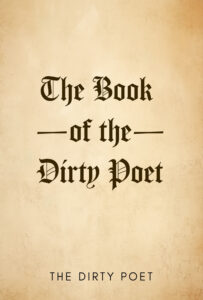
 The Profane Art of Staying Alive: The Book of the Dirty Poet from Roadside Press
Early in The Book of the Dirty Poet, its pseudonymous speaker reduces the secret of life to two pieces of advice: get lucky, and appreciate things while they are good, because they will not remain that way. Then comes the kicker: “don’t sweat the small stuff / the big stuff ’s coming.”
That miniature manifesto contains much of what animates this sprawling, funny, vulgar, and unexpectedly tender collection from Roadside Press. The Dirty Poet is a respiratory therapist, musician, husband, father, barfly, cyclist, aging bohemian, political crank, and philosopher of the one-liner. He is also somebody who has spent a great deal of time standing beside people trying not to die. The collision of those identities gives the book its peculiar voltage.
The poems rarely announce themselves as poetry in the ceremonious sense. Most are short, lowercase, conversational, and impatient with ornament. Some consist almost entirely of a joke. “bucket list,” for instance, reads: “my bucket list consists of stuff / i don’t want to do.” “40” begins with the childhood question of what being forty will feel like and ends, years later, with the realization that the narrator can no longer remember being forty. These are jokes constructed around disappearance. Time is the heckler permanently seated near the stage.
The Dirty Poet’s comedy often functions less as an escape from death than as a way of staring directly at it, and the hospital poems are consequently among the strongest in the collection. Here the swaggering persona encounters circumstances that cannot be swaggered away. In “grandpa,” a ninety-seven-year-old hospice patient apparently stops breathing after a treatment. His family crowds around while the narrator anxiously checks for life. Two minutes later comes a sudden gasp. Afterward, when a coworker remarks that the family is “a whole lot,” the poet answers: “you should see what happens when you kill grandpa.” The joke does not cancel the fear in the room. It releases it.
There is occupational authority behind this black humor. The narrator has actually been in rooms where bodies fail. In “big fat nothing,” respiratory therapists remember working through COVID, saving lives, watching others die, contracting the disease themselves, and discovering afterward that institutional gratitude amounts to very little. One coworker quits. The narrator’s response is considerably less heroic: “craig left / and i went back to work.”
Those lines reveal the collection’s working-class ethic. Work is exploitative, monotonous, ridiculous, occasionally noble, and unavoidable. The Dirty Poet is not a literary tourist visiting suffering for material. He has a shift to finish.
Beneath the advertised appetite for booze, sex, profanity, bad judgment, bars, and rock & roll is also a man preoccupied with love and its expiration date. “get busy” warns that family, cats, and even the self one once inhabited cannot be kept, so one had better start “soaking up the love.” The dirty poet keeps discovering, sometimes despite himself, that sentiment is harder to escape than death.
Music offers another defense against disappearance. The collection is saturated with bands, instruments, clubs, jazz, classic rock, and the peculiar tragedy of being an artist without becoming quite the artist one imagined. One poem recalls youthful life in a band — before adulthood somehow produced jobs, a house, children, cats, and a home gym. The punchline is also a small triumph: “we still have the band.”
In “my buddy,” the lifelong companion being praised eventually turns out to be music itself. It has accompanied the speaker through intoxication, frustration, transcendence, and failure, connecting him with the past while allowing “conversations with the future.” The poem concludes, “we’ve said good morning and passed out good night / but we’ll never say goodbye.” For all the collection’s anti-poetic posturing, this is essentially a statement of artistic faith.
The Dirty Poet swings at capitalism, racism, nationalism, wealth, Trump, war, religion, and assorted American hypocrisies. At times the poems are too eager to convert indignation into punchline, and the collection occasionally mistakes bluntness for finality. Its abundance of short pieces also means that not every joke earns its place; sometimes a gag remains merely a gag. The poet is most interesting when the wisecrack opens a trapdoor beneath the reader, revealing mortality, loneliness, class, love, or failure underneath.
Some of the finest poems therefore arrive when the usual noise drops out. “impossible city” remembers “that impossible city / called youth”; “spin” observes simply that “the world spins around / and the old folks fall off.” Elsewhere, the narrator rejects fantasies about lives he might have lived: “you can only be what you are / you can only do what you did.” The loudmouth gets quiet, and we hear what the loudness has been defending him against.
The collection ultimately proposes a rough philosophy: luck governs more than we admit; institutions are ridiculous; bodies betray us; youth disappears before we understand that we possessed it; death wins; and therefore pleasure, family, friendship, art, and laughter acquire something approaching moral urgency. “joke” may be the book’s shortest ars poetica: “the joke’s always been on me / but i laugh anyway.”
The Book of the Dirty Poet is uneven, excessive, profane, politically unsubtle, and occasionally juvenile. It is also alive in a way many more decorous collections are not. Its poems carry the atmosphere of hospitals and bars rather than writing workshops. At their best, they perform a difficult trick: making mortality funny without making it trivial.
The Dirty Poet knows the big stuff is coming. His answer is to work the shift, play the gig, love whoever is still around, raise a glass, make the joke, and write the poem before it gets here.
While a resident of New York City, Richard Modiano became active in the literary community connected to the Poetry Project where he came to know Gregory Corso, Allen Ginsberg, Anne Waldman, William S. Burroughs and Ted Berrigan. In 2001 he was a programmer at Beyond Baroque Literary/Arts Center, joined the Board of Trustees in 2006, and from 2010 to 2019, he served as Executive Director. The Huffington Post named him as one of 200 people doing the most to promote poetry in the United States. Modiano is the winner of the 2022 Joe Hill Prize for labor poetry and is a Pushcart Prize nominee.