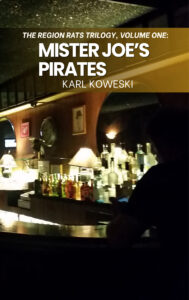
 Mister Joe’s Pirates by Karl Koweski (Roadside Press)
Karl Koweski’s Mister Joe’s Pirates is an unapologetically profane, funny, and unexpectedly heartfelt novel that finds surprising humanity in the fading industrial landscape of Northwest Indiana. At first glance, it appears to be a crude comedy about washed-up barflies coaching a hopeless Little League team. By the time the story settles into its rhythm, however, it reveals itself as something richer: a novel about grief, redemption, friendship, and the ways broken people sometimes become exactly what others need.
The narrator, Vic Lukasic, is one of the more distinctive voices in recent independent fiction. His worldview is soaked in beer, sarcasm, heavy metal, Cubs fandom, and working-class fatalism. Every page crackles with inventive profanity and outrageous observations, but beneath the bluster is a man haunted by disappointment — his alcoholic father, unrealized baseball dreams, the monotony of factory life, and the creeping realization that middle age has arrived without much to celebrate. Koweski wisely never asks the reader to pity Vic. Instead, he lets the humor expose the loneliness.
The novel’s greatest strength is its dialogue. Conversations ricochet between absurdity and sincerity with remarkable ease. Vic’s brother Pete, the perpetually inebriated Wobbly O, the foul-mouthed Little Leaguers, and the assortment of neighborhood misfits all possess distinct voices that make the world lived-in rather than merely comic. The banter is relentless, yet rarely feels manufactured. It recalls the best barroom storytelling traditions, where exaggeration becomes its own kind of truth.
The baseball itself serves as more than a backdrop. The Pirates’ season becomes a vehicle for examining mentorship and second chances. Vic initially accepts the coaching job out of spite — largely to defeat his childhood rival Lenny Pinarski — but gradually discovers that the ragtag collection of kids needs something beyond baseball instruction. They need adults willing to show up. The team’s gradual transformation mirrors Vic’s own reluctant growth, making the emotional moments land without sentimentality.
Koweski also deserves credit for his sense of place. “The Region” emerges almost as another character. The neighborhood taverns, aging Buicks, machine shops, funeral homes, and decaying ballparks evoke a blue-collar Midwestern community caught between nostalgia and decline. Rather than romanticizing the setting, the novel embraces its contradictions: rough language alongside fierce loyalty, dead-end routines alongside unexpected acts of kindness.
The humor will inevitably divide readers. This is not a polite novel. Nearly every page contains profanity, politically incorrect jokes, ethnic ribbing, and crude sexual humor. Yet these elements feel rooted in character rather than shock value. The jokes arise from the flawed people inhabiting this world, and Koweski trusts readers to recognize that affection often underlies the insults exchanged among friends. Readers looking for sanitized nostalgia should probably look elsewhere.
Perhaps the book’s greatest accomplishment is balancing its outrageous comedy with genuine emotional weight. Moments recalling Vic’s father, the death of the previous coach, or the quiet disappointments of adulthood provide an affecting counterpoint to the relentless jokes. Even as readers laugh at Wobbly O’s drunken ramblings or Pete’s larger-than-life antics, they become invested in characters who have spent decades stumbling through life without entirely losing their capacity for loyalty or compassion.
Mister Joe’s Pirates is a literary descendant of working-class comic fiction, filtered through Midwest tavern culture and Little League baseball. It has echoes of Charles Bukowski’s rough-edged honesty, the neighborhood camaraderie of Richard Russo, and the affectionate vulgarity found in the best blue-collar comedies, while maintaining a voice that is distinctly Koweski’s own.
Roadside Press has published a novel that is unlikely to appeal to everyone, but readers willing to embrace its abrasive humor will discover an unexpectedly warm and memorable story. Beneath the constant profanity lies a novel about men learning, almost against their will, how to care for one another and for the next generation.
Mister Joe’s Pirates is now available wherever books are sold including magicaljeep.com.
While a resident of New York City, Richard Modiano became active in the literary community connected to the Poetry Project where he came to know Gregory Corso, Allen Ginsberg, Anne Waldman, William S. Burroughs and Ted Berrigan. In 2001 he was a programmer at Beyond Baroque Literary/Arts Center, joined the Board of Trustees in 2006, and from 2010 to 2019, he served as Executive Director. The Huffington Post named him as one of 200 people doing the most to promote poetry in the United States. Modiano is the winner of the 2022 Joe Hill Prize for labor poetry and is a Pushcart Prize nominee.