Bird By Bird: Listing and ranking every Avian reference in “Things To Say When You Have Nothing To Say” by Kerry Trautman
Friends, I have a confession: I think I was wrong about bird poems. For all the mediocre bird verses out there, something about the new collection from Kerry Trautman just made me realize how much I enjoy them. There are some lovely bird poems in this book.
I don’t make the decision to dedicate nearly 1800 words to this subject lightly. My somewhat ironic hatred for bird poems is a large part of my brand as a poet, and it inspired my poem “A Poem About Birds,” in which I explicitly state, “I hate poems about birds.” Although my reputation as a hater of bird poems is somewhat exaggerated (I like birds, birds are nice), I stand firm with my assertion that a bird is worse than a loaded gun in the hand of an untrained poet. When I say I hate bird poems, I mean that I hate the type of cynical nature writing where the poet pretends I’ve never seen a sparrow before and feels the need to describe it to me as if they have discovered its majesty for the first time. We live in an era where living creatures are routinely reduced to metaphor, and I sometimes worry that the bird poem has become a gateway drug to more damaging patterns of writing about human bodies. I don’t care how many Mary Oliver books you’ve read – no poem you write about a bird will be more satisfying than experiencing that bird firsthand. The best bird poems acknowledge that paradox and use the bird as an impetus to discover something new about our relationship with the world around us.
Few writers accomplish this task better than Kerry Trautman.
Many bird poems reduce their subjects to metaphors for morality, daily wonder, or just a stand-in for some formal aspiration that lives well beyond the writer’s reach. Even though birds account for a small portion of the images in her newest volume, Trautman uses Birds to reflect something I find infinitely more human – a longing for distant intimacy. Kerry’s poems are constantly listening for birds and contemplating the limits of that listening. Consequently, birds enter her sensorium from the periphery, often as jagged, fragmented images that come into brief focus before flying away. Where some poets anthropomorphize birds or use them as metaphors for personal suffering (self-included), Trautman resists that impulse, instead using bird imagery to meditate on what cannot be reciprocated or fully understood. This quieter, more companionable sense of watching and listening results in one of the very best collections of poems by one of my very favorite humans.
Things to Say When You Have Nothing to Say (now available for purchase at Magicaljeep.com) represents a poet working at the peak of her powers. For someone who claims to be no more than a mirror, the self-examination in this work goes deeper into her interiority than anything I’ve read yet. While her verses work hard to veil any sense of confession, Kerry inevitably reveals herself through what she chooses to focus on. She uses her considerable skill as an observationist to reach sublime moments of truth within the awkward silences of American life. Trautman fills each poem with numerous domestic objects as metaphor, surprising and visceral human revelations, and of course, birds – so many birds.
As your reluctant bird poetry sommelier, I present you with my ranking of all 18 poems in the collection, which reference birds from least to most bird-like.
A Bit on the Ranking
All of the 70 poems in this collection have something to recommend (I particularly like “Listening to a Poet in a College Chapel as Autumn Rain Pelts Black Windows.” and “To Everyone I Could Have Fucked but Didn’t”, which sadly includes no birds) However for this exercise, I will focus only on the poems that reference birds. All poems without references to birds are omitted, with two exceptions that made it onto this list by accident.
Of course this is very serious work. Very very serious work ranking birds. As such, my ranking relies on a blend of four main criteria:
1.) Quantity of bird imagery – how much bird content or how many bird references the poem contains;
2.) The importance of the bird imagery to the poem’s trajectory – in other words, how deeply the bird images are woven into the emotional or narrative core of the poem; and
3.) The overall quality of the poem itself.
4.) throwing out all the criteria and just talking about the poems in the order I want to talk about them in.
To be as transparent as possible: I don’t take the ranking too seriously – this is all in good fun. The list format gives me an excuse to talk about many of the poems I like. Still, I tried to follow a certain intuitive logic that balanced my three main criteria. If a poem is packed with bird references, but the images don’t matter to what the poem is doing, I might rank it lower than a poem that pivots on a single, powerful avian moment. For example, a couple of these poems have much broader themes but end with knockout bird images that completely transform the poem’s mood or meaning. In cases where two poems seem tied, I let a standout bird phrase or an especially memorable image (even if brief) break the tie and tip my ranking. So, I’m balancing the birdiness with the poem’s universe’s unforgettable, meaningful birds. But again – and I cannot stress this enough – the ranking does not matter.
16. Be Fruitful (P 92) – In the final poem of the collection, Kerry references lonesome bees “uneventfully” whizzing through trees. Now, even as someone who believes in the technology of the self, I must admit that Bees are not Birds. Not only are these bees not birds, but they are also uneventful. However, to its credit, this poem features the phrase “with honeyed fruits soft as love and succulent as sex,“the least birdlike reference.
- Reservoir (P. 71) (*): On first glance, this poem is even less about birds than Be Fruitful. This short vignette between Kerry and her son centers on a brief encounter with the Findlay Reservoir near Riverbend Park. I love the use of italics here, and I find the tepid listlessness in her portrayal of this body of water compelling. As far as birds go, I’m ranking it above “Be Fruitful” for two reasons, and here’s where my own associations creep in. First, I have to own up to bringing some personal baggage: one time in 2019, I saw a heron fly over this same reservoir, and ever since, I can’t help but superimpose that image whenever I read this poem, even though the poem itself doesn’t reference any birds at all. Second, the poem evokes the gorgeous image of “wave-lets swish the boulders’ seaweed tutus.” While this isn’t meant as a bird reference in Trautman’s text, I personally stumbled upon several Sound journals that metaphorically compared birdsong to wavelets, which might be a stretch, but it lets my imagination fill the gap. So, to be clear: any mention of birds here is entirely my own projection and not present in Kerry’s poem. Still, even an imagined birdsong (or a misplaced heron memory) feels slightly more birdlike than uneventful bees.
14. How to do things (p. 74)
okay.. everything from here on out is an actual bird reference. This poem pops out to my eye because Kerry is going ham with the letter spacing and margins. With purpose, though. The slow expansion of words feels like waves on a beach, perfectly evoking the vibe of a Corona commercial. This poem mentions “ordinary pairs of robins swirling on grass.” Kerry’s phrasing describes a quotidian and unremarkable bird encounter. I am only placing this reference this low because Kerry goes out of her way to describe these Robins as ‘ordinary.” I feel sad for these robins. to know that their defining poetic characteristic is that they are ordinary, but I’m happy to know they had a good time swirling in the grass, which sounds very fun. At the same time, the decision to highlight their ordinariness taps into a classic poetic impulse—finding wonder in the commonplace, and suggesting that even the most everyday moments can carry quiet beauty and meaning when we pay attention.
- What I Want (P.14-15)
In a list with so many bird images, I found myself caught off guard by this reminder that we eat birds.. “the way Chicken tastes better when roasted in someone else’s kitchen”
12. Revelry (P. 43). In this lovely block of prose flash poetry, Kerry opens with the phrase “Too many birdsongs to count.” This is the sign of a truly sublime moment. If the sonic image of birdsong is too dense for Kerry to describe, we have truly found paradise among the chirping, the Diet Coke, and the pastrami on wheat.
11. Flown Loose (P. 50) – In this virtuosic poem, Trautman imagines herself as a rogue blanket tossed by the wind across a landscape. In the process, she describes “a day in a still ditch with toads and redwing blackbirds,” which sounds like a good time.
10. To The Bleak March Highway (6): Another paragraph-length prose flash poem, “To The Bleak March Highway” features this list’s first reference to the predator class of birds. In this poem, Traubman uses several dread-filled descriptions of “gargoyle hawks,” “lurking turkey vultures,” and “yard-sized birds.” While predators are often majestic, Kerry’s drive-by descriptions present a less flattering impression. The claustrophobic form of the prose paragraph adds to the proceedings’ eerie, ominous effect. Lurking is such an unpleasant word, and Kerry paints an overall bummer vibe around these birds. To misquote Emily Dickinson, there is a certain slant of lurking Turkey vultures that oppresses.
- Old West End Festival (P 44) – Kerry’s experiences of the Old West End Festival in Toledo Ohio, are very different from mine. (see also: the poem “Galesville, Wisconsin” from my upcoming collection {f}ragile Nests.) But this poem contains one of my very favorite strings of words in the entire book “a cardinal, a bluejay, a joyous helloooo! shrieked from a moving car window,” fully capturing the joy of Toledo at its absolute best.
- Things We Don’t Think About (42) the dominant extended metaphor here is flowers, but we do have a lovely cameo by the underdiscussed Goldfinch: “seeking seeds with zeal of youth, fanning heat in tiny flaps of feathered celebration.” strong and vivid images. I also like that Kerry gave the goldfinch something to do in this poem.
7. Winter and I Want – (26) An ekphrastic this time, a poem inspired by Karen LaMonte’s glass sculpture Dress Impression with Train. Trainman writes about the sculpture like a scriptive object, a blandishment rustling passion and unresolved affect. Having an object to project her hopes, fears, and desires onto allows Kerry to bestow the language with a soaring urgency. It makes sense that we get one of the cleanest bird images in this poem, yet drawn secondhand: “my cloth draped as Artemis spotting hawks— still and dark like gingerbread against frosted branches and layers of snow and snow.”
- Flightless (10) – This poem focuses on flight itself and flight patterns and compares two images: that of a jet and that of a bird of prey. This is much more an airplane poem than a bird poem. Yet the ending elevates the bird image with this final turn. “Maybe it’s all a matter of flight patterns of what we leave behind— exhaust trails, tailing or tailfeathers. She sketched a feather willed it to fly.”
- Translations from The English (68): In a few months, I have a book coming out which uses extended bird metaphors to explore the ephemerality of love and home. It took me 90 pages to say what Kerry said in 15 words: “When she says Look! A heron, what she means is: Some day, everyone will leave.”
4. All Roads Lead to the Gasconde River (3) in this, the first poem in the collection, the reader is given a command that unlocks the entire collection: Follow the gurgle and heron. The advice pays off almost immediately as Trautman introduces us to a hummingbird lapping up sugar water amid a plethora of images depicting a majestic 4-wheel drive through the Ozarks.
- Fort Lauderdale Vacation (66-67). This lovely vacation daydream gives us a rolling pastoral of recurring lizard and bird images. Following Kerry’s mind wander through the landscape gives us a tour of Jason Robert Brown lyrics, Pelicans, Snow Geese, Blue Jays, dinosaur bones, and iguanas. As someone who will probably never make it back to Florida again in my lifetime. I appreciate the transportive quality at work here.
- Things We Don’t Hear (p 52) – In terms of sheer number of birds that show up in this poem, Things We Don’t Hear.. lights up the Merlin app more than any other poem in the collection. This poem gives us Pelicans, bitterns, Sandpipers, Herons, Mute Swans, and Gulls all set against the milieu of Lake Erie birding culture. Yet what I most appreciate is that, for being a poem about birds, this isn’t actually a poem about birds:
Trautman uses the birds as a simile to explore the frustration of communicating with someone who is not listening. This elevates birdsong to an ironic underscore to a growing rage:
“Every conversation I have with you might as well be spoken
into the mouth of a Black Scoter diving under Lake Erie.”
Here is the textbook example of how to use bird as embodiment rather than metaphor. The birds here give presence to the paradox of communication. How can we make all the sounds in the world and still be fully incapable of understanding each other when the other person doesn’t even know what to listen for?
- The Sound of Your Own Voice (p7) – This poem represents my platonic ideal for a bird poem. Kerry uses the phenomenology of birdsong to interrogate universal insecurities of knowing and being known in the world. Plus, Kerry is having so much fun naming birds in this poem. We get terns and wrens and greater and lesser tits, pitpits and plowers, blackbirds and meadowlarks, Hege sparrows, house sparrows, and pipistrelles (I had to look that one up. weird flex, but okay ?).
But then the poem executes the difficult magic trick of referencing birds and then organically unpacking the meaning of referencing birds:
“A friend tells me I write about birds a lot. And I do, though they’re basically strangers. There are birds I recognize by body or sound, but few I know by both. I want to befriend them.”
These two lines become the key to understanding every other bird in the collection, if not the entire collection itself. As much as this poem is about the sounds of the Terns and Wrens, the Tits the Pit, we see a self-conscious attempt to recon with the intent in naming these “friends” . We witness the focused yet distanced gaze through which Kerry Trautman sees the world. The single-thought floating stanzas give this poem a stream-of-consciousness feel, as Trautman walks the reader through a serene, intense, and extremely detailed phenomenology that pivots between the joy of naming and the terror of being named. So much of the poetry in this collection is about the giant revelations that can only happen within the interiority of Trautman’s mind that the terror of breaking that cloister becomes palpable.
I think this is why there are so many birds in Kerry Trautman’s writing. Reciprocation is impossible. When poets write about the humans in our lives that we argue with on vacation or drive to and from band practice, we express very private and sometimes consequential feelings for which the subjects of the poems will also have emotional stakes. We don’t expect birds to understand us or listen to us. Birds just bird… They provide us only with their sounds and images and their behaviors – we have to write the rest.
I think that’s why I continue to use birds as a sight for meditation, and I think it’s why I continue to be enchanted by the quiet birdsong of Kerry Trautman’s poetry. You can purchase the book now at Magicaljeep.com.
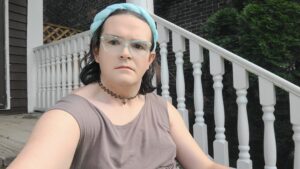 Pella Felton is a poet, teaching artist, and lover of birds. Her upcoming collection {f}ragile Nests is available for presale at Magicaljeep.com and features enough bird poems to make this entire article wildly hypocritical.