
The Workhouse
The morning chime reverberated through the room. Time to get up and go to work. Every day, the same thing.
Routine.
Boredom.
Pain.
Ten seconds later came the harsh demand over the speaker, “Work or punishment.”
Worker 373 slipped on her coveralls and left her room. The other workers in her sector stood single file in the corridor. On the next chime, they marched, the rhythmic sound of worn boots tapping the cold concrete floor.
They marched, no one speaking, no one daring to get out of line, into the cavernous workhouse. The workers shuffled and limped to their stations, heads down, silent. Worker 373 sat and stared at the box on her table, filled with old computer parts. Her job, disassemble the parts and soak them in leaching fluid. Each day the same. Finish one box, get another. No variety. No choice.
A second chime, followed by the morning announcement, “You are here to work. No talking. Work is your life. Work is your home. You will work until you die. The Company provides food, clothing, and shelter. You will be grateful. Be productive and work hard.”
Worker 373 looked sideways at her neighbors, female Worker 555, who’d arrived two years ago, and male Worker 14,329, who’d arrived only three weeks ago. Workers were taken from their homes because the government decided that women at the age of fifty-five and men at sixty were a burden on society, but apparently able enough to work for the corporations instead of using expensive robotics. Fifty-five, the age where women were deemed useless, unable to reproduce or contribute in a meaningful way, a drain on resources.
So, off to the prison-like corporate warehouses they went. No escape, no legal representation, no hope. Worker 373 had heard, before she was taken, of people hiding or families faking burials of their loved ones to fool the government, but it never worked and those trying to help were arrested. The corporations grew wealthier and more powerful through unpaid labor.
Worker 373 picked up a circuit board and began breaking it down. She gently slipped the pieces into the leaching fluid, careful not to splash the caustic liquid on her hands.
After four hours with no break, the lunch chime sounded and the workers stood, stretching their aching backs, and headed to the bathrooms. The toilets, lined up in a row, had only a short wall separating the women’s from the men’s. New workers arriving at the Company had the duty of cleaning them for the first year, then they were put on a workstation.
In line for the bathroom, she leaned close to Worker 555 and whispered, “How are you holding up?”
Worker 555 kept her head down, but whispered back, “The arthritis in my back hurts all the time from sitting so long. I can hardly tear the circuit boards apart now because my fingers are numb. And you?”
“I can’t sleep well because of the pain all over my body.”
Worker 555 nodded and wiped at her eyes. “I don’t think I’ll last much longer. I want to see the real sky one last time, instead of those blue tinted UV lights above the workhouse floor.”
Worker 373 touched Worker 555’s hand. Oh, how she missed the sky, brilliant blue speckled with snowy white clouds. She often dreamed of fields of flowers, trees full of brilliant green leaves. But that’s all it was, a dream.
No more joy.
No more freedom.
Trapped forever until death released her.
Worker 373 sighed. “These workhouses are inhumane. Long time ago, I petitioned to end the workhouses. I spent a year in jail for that. My family made me keep quiet, saying things would change. They didn’t, and now here I am.”
The line edged forward.
She’d always suspected that the corporations paid the government to look the other way, ignoring the suffering. All that mattered was money and power. Subjugate the population so they couldn’t fight back.
After the bathroom, with ten minutes left for lunch, Worker 373 sat at the community table and grabbed an orange, two slices of white bread with peanut butter smeared on each half and ate fast. She downed a glass of water and rushed back to her workstation before the chime.
A manager strolled around holding his head high. Worker 373 noticed something poking out of his apron pocket. It looked familiar.
The manager strode toward her. “Your eyes belong on your work!”
Worker 373 stared at the pocket.
“I said, your eyes belong on your work!” The manager got so close she could smell his stale breath. He cuffed her on the back of the head.
Quickly, she grabbed the item in his pocket and slipped it under her leg. She lowered her head and picked through her box. The manager huffed and walked away.
She pulled the object, a lighter, from under her leg and flicked it. An orange flame danced. She stood, walking down the rows of workstations, and tipped each leaching fluid container onto the floor, creating puddles as she went.
She wouldn’t be told what to do anymore. Never again. She stood in the middle of the workhouse and flicked the lighter, leaned down and put the flame close to the floor. The flammable leaching fluid ignited. Flames spread all around and licked upward, catching workstations on fire. Screams filled the room. Workers ran in all directions.
An announcement came, “Stay at your workstations! You will work!”
Worker 555 stood on her workstation and shouted, “We’re free! No more work! They don’t own us! We end this on our terms!”
Ceiling tiles burned and tumbled. Windows shattered.
“You…work…stay…” The speaker melted.
Worker 373 ran through the flames and stood with her friend. “This workhouse is no more. It will take us with it, but this is our final stand. Rejoice! We are free!”
Smoke.
Flames.
Freedom.
Worker 373 smiled as she caught a glimpse of blue sky where part of the roof collapsed.
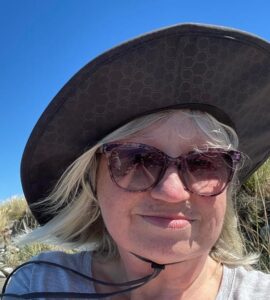 Born in Sydney, Australia, Sofia Diana Gabel is a multi-genre author now living in the Pacific Northwest. Her published works include novels, novellas, and stand-alone short stories as well as inclusions in anthologies. She holds two bachelor’s degrees, and a master’s degree with extra coursework in creative writing. In addition to writing, she loves hiking forest and coastal trails, hanging out with family, and traveling as much as possible. She’s a wanderer at heart and finds it hard to settle in one place for long. And why should she? There are so many places to explore!