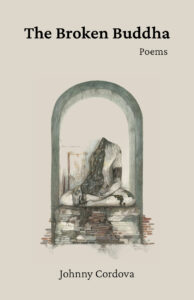
 The Broken Buddha by Johnny Cordova (Roadside Press)
Johnny Cordova’s The Broken Buddha is a restless, confessional pilgrimage—one that moves through Southeast Asia and India before circling back to the American West, to fathers and daughters, to addiction, grief, music, and memory. Published by Roadside Press, the collection reads like a spiritual travelogue written in the aftershock of personal wreckage. Its central tension—between renunciation and appetite, transcendence and flesh—gives the book its voltage.
The opening poem, “The Broken Buddha,” establishes the governing metaphor: a marble statue dropped by a careless monk, glued back together, unwanted by collectors. “I bought him because I too missed a step,” the speaker says, binding object and self in shared fracture. The poem’s incantatory repetition—“I bought him because…”—becomes both justification and confession. Brokenness, here, is not a flaw to be repaired but a condition to be inhabited. The speaker seeks instruction not from perfection but from damage endured.
In the first section, “All Night Rain,” Cordova situates his speaker in Thailand’s monasteries and sex districts, invoking Zen lore and figures like Taisen Deshimaru, who famously blurred the boundary between sacred and profane. The long poem “Nana” moves from forest meditation to Bangkok’s go-go bars in a single breath. The clarity attained in silence does not prevent descent into desire; rather, insight and indulgence coexist. The effect is unsettling by design. Cordova refuses to tidy up the contradiction.
There are moments where the explicit detail risks overwhelming the contemplative frame. Yet that excess seems intentional. The narrator understands the transactional nature of his encounters and indicts himself as participant in a global economy of longing. In “Thai Monks,” when young monks ask, “Are Thai women good at sex?” the laughter that erupts is not cheap comedy but exposure: celibacy and obsession share the same mind. Cordova’s strength lies in allowing such scenes to remain morally unresolved.
Throughout, rain functions as sensual and spiritual solvent—“All night rain in the jungle… the more it resembles revelation.” Desire and weather merge. The body becomes monsoon-soaked terrain.
In “Sketches of India,” the poems grow shorter, more observational. Tiruvannamalai, Haridwar, Kerala—pilgrimage sites rendered with spare brushstrokes. The Ganga flows through these pages as both literal river and archetype. The section’s power lies in its tonal shift: less fevered, more spacious. The speaker is still implicated, but the gaze softens.
Cordova’s portraits of gurus and monks avoid hagiography. In “Boys on an Ashram,” “God is kept alive / by praise.” The line is ambiguous—devotional or ironic? The book thrives in that ambiguity.
The invocation of figures like Jack Kerouac and Zen poets such as Ryokan (echoed in “These Things”) situates Cordova within a Beat-inflected lineage. Yet unlike the ecstatic outward thrust of On the Road, this collection is shadowed by reckoning. The spiritual quest here is not romantic escape but aftermath.
The third section, “Ashes,” is the emotional core of the book. The earlier oscillation between monastery and brothel gives way to the irrevocable: the death of a daughter, the aging of parents, the erosion of youthful mythologies. In “What She Carried” and “The Day We Buried You,” the language strips down. Ceremony replaces spectacle. The careful placing of stones around the grave becomes an act of composition itself.
These poems are the most disciplined in the collection. Gone are the neon-lit excesses; in their place, desert light and restraint. “Ashes / after Kobayashi Issa” closes the book with devastating simplicity: “Our lives are but a dewdrop. / This great silence remains.” The nod to Kobayashi Issa underscores the arc—from indulgent narrative sprawl toward distilled awareness.
Elsewhere, Cordova revisits American adolescence: posters of Jim Morrison replacing Charlie’s Angels, arguments with a father who once shone on a basketball court. These cultural touchstones ground the global wandering in a specifically American masculine inheritance—restless, hungry, half-articulate. The elegy for the Oakland Raiders doubles as lament for lost boyhood. Pop mythology gives way to mortality.
Cordova works primarily in free verse, favoring narrative propulsion over compression. Some poems could benefit from sharper pruning; repetition sometimes feels indulgent rather than incantatory. Yet the looseness is part of the book’s aesthetic—roadside dharma, confession without a net.
At its best, The Broken Buddha achieves a rare tonal braid: erotic candor, spiritual inquiry, and paternal grief woven into a single thread. The speaker does not resolve his contradictions; he ages inside them. If the early sections flirt with romanticizing transgression, the later poems dismantle any illusion that awakening exempts one from consequence.
The Broken Buddha is not a book of serenity. It is a book of aftermath—of a man who has tested the edges of appetite and returned to sit with what cannot be undone. Its governing insight is simple and hard-won: once broken, one stays broken. The task is not restoration but attention.
Cordova’s collection ultimately argues that brokenness itself may be a form of initiation. The statue with the cracked neck, the father who failed, the lover who wanders, the mourner arranging stones in desert rain—all are versions of the same figure, seated in imperfect stillness, waiting not to be claimed but to see clearly.
The Broken Buddha by Johnny Cordova is available at https://www.magicaljeep.com/product/buddha/VA3K3OQYZN5BZTPDSGEWHF6K
While a resident of New York City, Richard Modiano became active in the literary community connected to the Poetry Project where he came to know Gregory Corso, Allen Ginsberg, Anne Waldman, William S. Burroughs and Ted Berrigan. In 2001 he was a programmer at Beyond Baroque Literary/Arts Center, joined the Board of Trustees in 2006, and from 2010 to 2019, he served as Executive Director. The Huffington Post named him as one of 200 people doing the most to promote poetry in the United States. Modiano is the winner of the 2022 Joe Hill Prize for labor poetry and is a Pushcart Prize nominee.